How Long Does Local Listings Management Take to Fix NAP Drift?
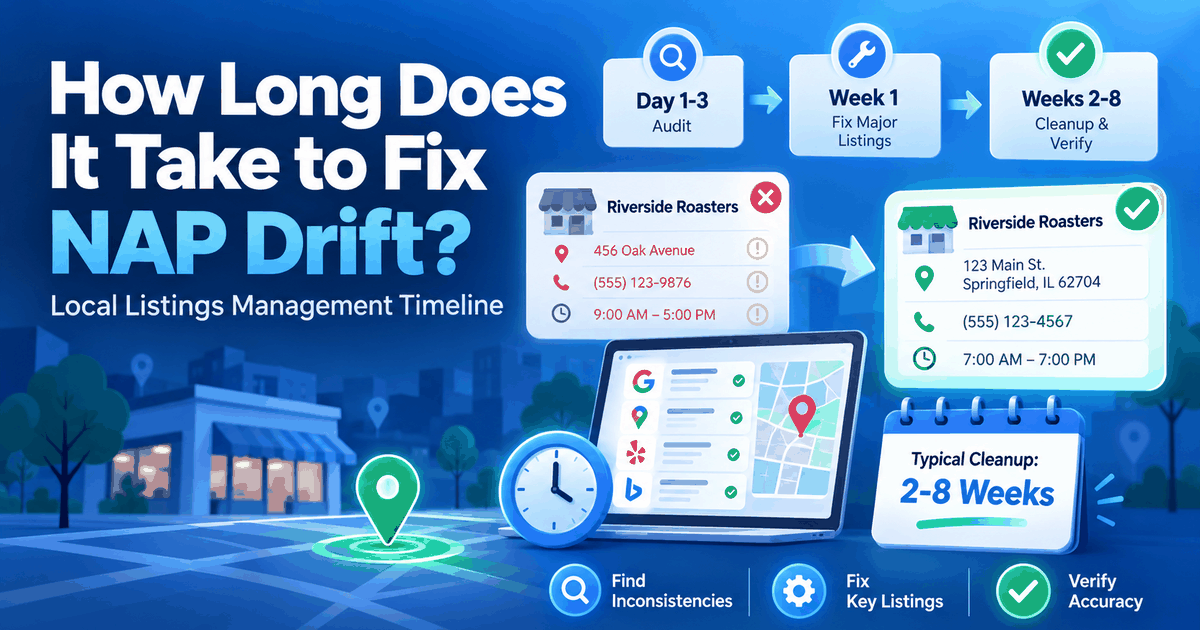
NAP drift can start with one small change. A business moves, replaces its phone system, adjusts its public name, changes suites, or opens a new location. Google shows the new information, but Yelp still has the former phone number. An industry directory has the old address. A duplicate map listing survives from the previous location. Several weeks later, one of those older records appears again somewhere else.
Fixing the first listing may take minutes. Fixing the entire problem usually takes longer.
For planning purposes, a straightforward local listings cleanup often needs roughly two to eight weeks before you can confidently verify the major and long-tail sources, although that is an operational planning range rather than a universal platform SLA. Simple edits on directly managed profiles can appear within hours or days. Complicated ownership, verification, duplicate, relocation, and legacy-citation problems can remain open for several weeks or longer.
The difference comes from the way platforms process updates. Google says Business Profile edits usually take up to 10 minutes to review but can sometimes take up to 30 days. Yelp says suggested business-information updates are typically resolved within 24 to 48 hours, while complicated cases take longer. Other directories may process submissions on their own schedules.
The goal of local listings management is therefore not to make every citation identical overnight. It is to establish the correct business information, fix the sources with the greatest customer impact first, track the remaining discrepancies, and verify that old information does not return.
For the broader operating process, see Local Listings Management in 2026.
How Long Does NAP Drift Take to Fix?
Here is a practical 2026 planning model. These are planning ranges, not promises.
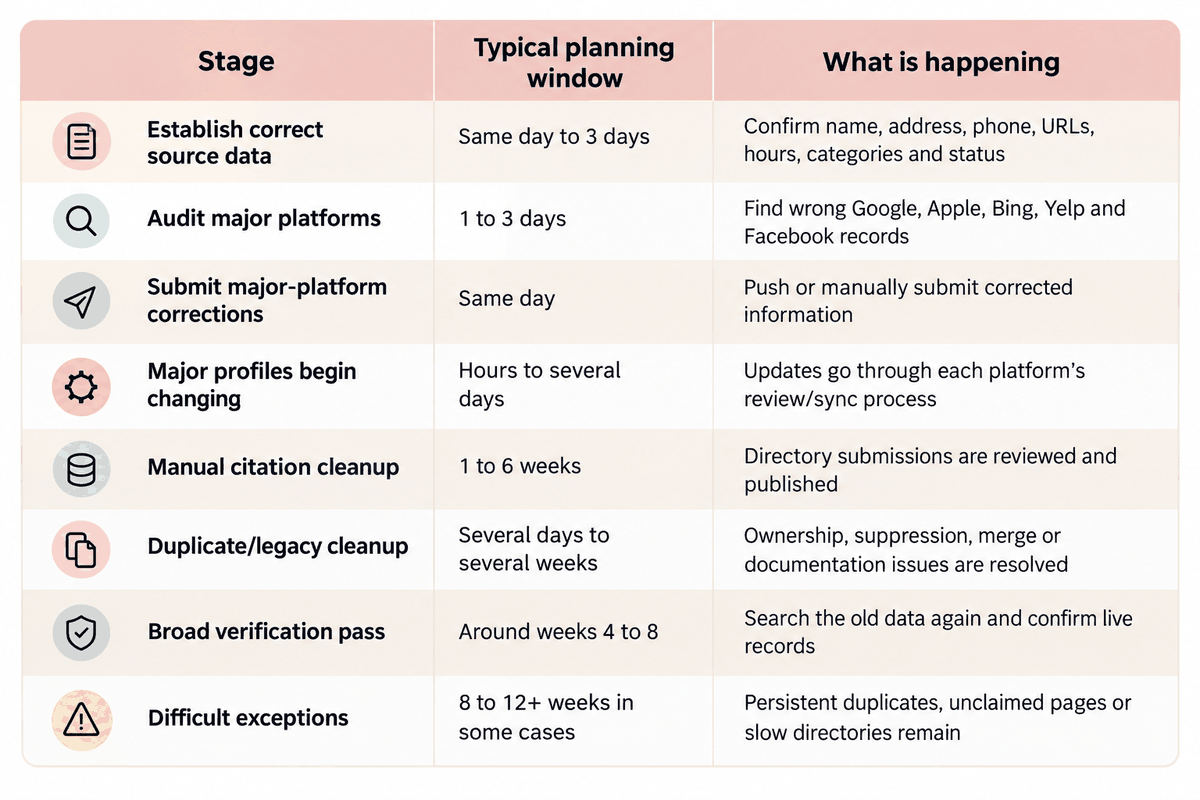
Published platform timings vary considerably. Google says an edit may review in about 10 minutes or take as long as 30 days. Yelp says most suggested edits resolve within 24 to 48 hours. BrightLocal says its manual Citation Builder submissions are handled within seven days and can take one to six weeks to become live depending on the directory. Synup documents up to 72 hours for new verified location information to synchronize across its publishing partner networks.
That is why “How long does citation cleanup take?” does not have one number.
What Is NAP Drift?
NAP stands for:
- Name
- Address
- Phone number
NAP drift occurs when those fields gradually stop matching the business’s current real-world information across its online presence.
Suppose the approved business information is:
Summit Dental Group
450 Market Street, Suite 300
Austin, TX 78701
(512) 555-0180
You might still find:
| Source | Incorrect information |
|---|---|
| Correct | |
| Apple | Suite 200 |
| Yelp | Former phone number |
| Bing | Correct |
| Industry directory | Old business name |
| Legacy directory | Former address |
| Duplicate listing | Old name + old address |
| Website footer | Correct |
| Old location page | Still indexed with old address |
That is NAP drift.
The term is useful operationally, but NAP drift itself is not a special Google-defined metric or published ranking factor.
It can also include more than traditional NAP. Modern business information consistency should account for website URLs, operating hours, categories, map coordinates, open/closed status, services, attributes and location pages.
Google explicitly advises businesses to keep their Business Profile information complete and accurate. Google says local results are mainly determined by relevance, distance and prominence. It does not publish an “NAP consistency score” or guarantee a ranking increase from making every directory use identical punctuation.
Read Google’s official local ranking guidance
For a basic citation definition, see What Is a Local Search Citation?.
What Causes NAP Drift?
Most NAP inconsistencies are not created by one dramatic error. They accumulate.
A business changes its phone number, and marketing updates Google immediately. The website follows the next day. Nobody remembers the chamber-of-commerce profile.
Six months later, the business moves. The old phone and old address now exist together on some sources, while other directories contain the new address and old phone.
Common causes include:
- business relocations
- suite or unit changes
- new phone systems
- call-tracking numbers
- rebrands
- ownership changes
- franchise transfers
- business mergers
- store closures
- separate agency spreadsheets
- old directory submissions
- employee-created listings
- customer-suggested edits
- aggregator or partner feeds
- duplicate listings
- profiles owned by former staff or agencies
- corporate and local teams publishing conflicting information
Google itself can also change profile information when it receives information from sources such as user reports or licensed content. Google says some suggested changes may be automatically published when supported by public information.
See how Google handles updates to Business Profiles
This helps explain why incorrect business information can sometimes return even after you corrected it once.
Why Don’t Listing Corrections Update Everywhere at Once?
Every publisher controls its own database and publishing rules.
A listing-management platform can send the correct information to multiple destinations, but the receiving directory still decides how the update is handled.
Some services support direct or two-way synchronization. Others accept submissions that they review independently.
Semrush, for example, distinguishes between “Dual Sync” publishers, where information can be synchronized automatically, and “Submission” publishers, where publication remains under the directory’s control. Semrush explicitly notes that it cannot guarantee that every submission publisher will accept or permanently protect submitted information.
That difference creates several possible states:
Submitted means the correction was sent.
Processing means a platform or vendor is working on it.
Published means the corrected information appears publicly.
Verified means you checked the public listing yourself.
Those terms should not be treated as interchangeable.
For NAP cleanup, the final state you want is verified.
How Long Does Google Business Profile Take to Correct NAP Information?
Google publishes one of the clearest timing ranges.
Google says edits to verified Business Profiles usually take up to 10 minutes for review, but in some cases they can take up to 30 days. That applies to profile edits such as contact and location information.
Google’s official Business Profile edit timing
A phone-number correction might therefore appear quickly, while an address or business-name change may face more scrutiny.
Certain changes can also trigger verification requirements. Google notes that changing a verified business name can require verification again.
Do not keep resubmitting the same correction because it did not appear in ten minutes. First check whether the edit is:
- accepted,
- pending, or
- not approved.
If it remains pending, treat it as an unresolved listing ticket rather than immediately creating another Business Profile.
How Long Does Yelp Take to Update Business Information?
Yelp says suggested business-information updates and new business additions are typically resolved within 24 to 48 hours.
More complicated cases can take longer because Yelp may check its own user-generated information, the official business website, social profiles, third-party information or direct communication with the business.
Yelp also notes an important distinction for claimed businesses: an owner editing information while signed into Yelp for Business may see the update appear immediately, but the edit can still be reviewed and later rejected.
Yelp’s official business-information update timing
For a normal phone or hours correction, a few days is a reasonable monitoring window.
For a relocation, rebrand or substantial business change, plan for additional review.
How Long Does Apple Business Take?
Apple provides management tools for keeping business locations current across Apple services, including Maps, Siri and other Apple experiences.
Apple does not publish one universal SLA for every ordinary location-data edit.
It does publish a timing for one important listing-management problem: if you request management of a location that another organization already manages, Apple’s transfer review can take up to five business days.
Apple’s official location-management guidance
The operational rule is therefore simple: submit the correction, monitor its status and verify the live Apple place card rather than assuming all Apple changes follow a five-day schedule.
How Long Does Bing Places Take to Update?
Microsoft directs businesses to Bing Places for Business when they need to add or change information appearing in Bing Maps search results.
Microsoft’s official business listing guidance
Microsoft’s current support page does not publish one universal update SLA comparable with Google’s 10-minute-to-30-day range.
For planning purposes, Bing should therefore remain “pending” until you see the corrected public result.
Do not invent a fixed 24-hour or 72-hour promise where Microsoft does not provide one.
How Long Does Citation Cleanup Take?
Manual citation cleanup usually takes longer than editing Google or Yelp.
BrightLocal’s current Citation Builder information provides a useful example of why. It says manual submissions are generally completed within seven days, while those submissions may become live on directories in one to six weeks, depending on the site.
That does not mean every directory on the web uses a one-to-six-week SLA. It does provide a reasonable illustration of how the long tail differs from direct profile editing.
A citation project may involve:
- finding an outdated record,
- determining whether it is claimed,
- creating an account,
- requesting ownership,
- submitting the correction,
- passing moderation,
- waiting for publication,
- rechecking the public record.
The submission itself can take five minutes.
The complete correction may take weeks.
For directory targeting, see Submit Citations to Top 50 Sites.
A Realistic NAP Cleanup Timeline
For a typical US business, a well-run project can follow this schedule.
Day 0 to Day 2: Establish the Source of Truth
Do not begin by editing directories.
First establish the correct:
- real-world business name,
- street address,
- suite number,
- primary phone,
- local landing-page URL,
- regular hours,
- special hours,
- primary category,
- operating status,
- map coordinates,
- store code if applicable.
Record old information as well.
If you are correcting a move, keep the previous address and phone in separate fields. You will need them later to search for legacy citations.
For a quick starting point, run the 15-Minute Local SEO Audit.
Day 1 to Day 3: Audit Customer-Facing Platforms
Check Google Business Profile, Apple, Bing, Yelp and any major industry-specific platform.
Search manually rather than relying entirely on a listings dashboard.
Try:
business name + city
business name + phone
business name + street
old business name
old phone number
old street address
The old data searches often find the listings that a normal brand search misses.
Day 2 to Day 5: Fix the Highest-Impact Discrepancies
Correct customer-facing errors first.
A useful priority order is:
| Severity | Example |
|---|---|
| Critical | Wrong phone, wrong map pin, closed location marked open |
| High | Former address, major name mismatch, wrong location URL |
| Medium | Old secondary category, unit-format disagreement |
| Low | Punctuation, capitalization or cosmetic formatting |
The 2026 multi-location operating checklist follows the same principle: customer-impacting problems such as wrong phone numbers, hours, pins and open/closed status get escalated ahead of cosmetic differences.
Week 1: Verify Primary Platforms
Check the live Google, Apple, Bing and Yelp pages.
Do not mark the job completed because a dashboard says “sent.”
Record:
| Platform | Submitted | Live | Verified | Remaining issue |
|---|---|---|---|---|
| Sep 23 | Sep 23 | Yes | None | |
| Apple | Sep 23 | Pending | No | Address |
| Bing | Sep 23 | Sep 25 | Yes | None |
| Yelp | Sep 23 | Sep 24 | Yes | None |
Weeks 1 to 4: Work Through Directories and Data Sources
Now move into broader citation cleanup.
Focus on directories that actually appear when searching the business or old NAP information.
Fix high-value industry sources before spending time on obscure profiles.
Weeks 2 to 8: Resolve Duplicate and Legacy Listings
Duplicates often become the slowest part of the project.
Some can be suppressed quickly. Others require proof that you own the business, documentation connecting the former address to the current one, or manual publisher review.
Weeks 4 to 8: Run the Verification Audit
Repeat every search you used at the start.
Search:
- old phone number,
- old address,
- old business name,
- brand + city,
- brand + old street.
Compare the results against your baseline audit.
The cleanup is approaching completion when old records either disappear, clearly show the business as moved/closed where appropriate, or no longer compete with the current authoritative record.
Why Does Old Business Information Sometimes Come Back?
NAP drift can return because correcting the visible listing does not always correct the underlying source that supplied the bad data.
Google states that it can use user reports and licensed information to update Business Profiles.
Other publishers may also receive information through third-party feeds, partner relationships or user edits.
This creates a common sequence:
- You correct Directory A.
- Directory A looks right.
- An older data source still contains the former phone number.
- A later refresh introduces the old number again.
- Your listing appears to “revert.”
The durable fix is not repeated manual editing.
It is finding which sources still hold the former information and reducing the number of conflicting records.
Does NAP Consistency Still Matter for Local SEO in 2026?
Accurate business information matters. The idea that every abbreviation must be character-for-character identical across every website is less useful.
Google’s current guidance says businesses with complete and accurate information are more likely to appear in relevant local results. Google identifies relevance, distance and prominence as the primary factors affecting local results.
So focus on semantic accuracy.
These two addresses normally describe the same place:
175 Main St.
175 Main Street
These may not:
175 Main Street, Suite 100
175 Main Street, Suite 700
Likewise:
(312) 555-0182
and an old disconnected phone number are a meaningful conflict.
A punctuation difference is rarely the first problem your operations team should fix.
An old phone, former address, duplicate map profile or closed location still marked open should be.
How Do Duplicate Listings Affect the Timeline?
Duplicates can turn a simple cleanup into a much longer project.
A normal citation edit asks:
“Can we replace this field?”
A duplicate cleanup asks several questions first.
Is the second profile really a duplicate? Is it a previous location? Does another owner control it? Is it an old practitioner listing? Does it contain reviews? Does the publisher permit a merge? Is proof required?
Semrush, for example, says its Listing Management duplicate-suppression process can take up to 72 hours once a qualifying duplicate is being processed, but listings that do not match enough identifying data may require additional documentation.
Synup similarly explains that flagging a duplicate sends a removal request to the publisher. It does not directly delete the listing itself.
This distinction matters.
A software dashboard can identify the duplicate immediately.
The publisher still controls the final outcome.
How Should Multi-Location Businesses Fix NAP Drift?
A 100-location business should not treat NAP cleanup as 100 separate SEO projects.
Create one structured master record per location.
Each record should have a stable store code and fields for:
| Field | Example |
|---|---|
| Store code | TX-0142 |
| Approved name | Summit Dental |
| Address | 450 Market St, Suite 300 |
| Phone | (512) 555-0180 |
| URL | /locations/austin-market/ |
| Primary category | Dentist |
| Status | Open |
| Last changed | Sep. 18, 2026 |
| Last audited | Sep. 23, 2026 |
| Data owner | Local SEO Operations |
Then manage discrepancies through an exception queue.
For example:
- Critical: 9 locations
- High: 17 locations
- Medium: 46 locations
- No mismatch found: 128 locations
That is more useful than telling leadership that the company has “3,400 listings.”
The site’s Local Listing Management Checklist for US Multi-Location Brands uses the same source-of-truth, audit, duplicate and reporting model.
How Long Does NAP Cleanup Take for 100 Locations?
The answer depends more on error volume than location count.
A 100-location company with one controlled source of truth and a listings platform may correct a chain-wide phone-format issue rapidly.
A 20-location company with old franchise owners, duplicate profiles, former addresses, and conflicting spreadsheets can take much longer.
A useful operational estimate is:
| Network condition | Planning range |
|---|---|
| Clean master data, minor discrepancies | 1 to 3 weeks |
| Moderate directory drift | 3 to 8 weeks |
| Moves, rebrands and many duplicates | 6 to 12+ weeks |
| Ownership/verification disputes | Case-by-case and potentially longer |
Again, these are planning windows for the project, not publisher guarantees.
Do not promise a client that 2,500 citations will all be corrected by the same calendar date.
Instead, report progress by platform and severity.
Local Listings Management Platforms That Can Help Fix NAP Drift
The following tools use different methods to distribute, monitor or correct business information. This section is not a ranking.
1. BrightLocal
Best fit: Businesses and agencies that want a mix of fast synchronization on major platforms and manual citation cleanup on broader directories.
BrightLocal separates ongoing listing synchronization from citation-building work. Its Active Sync product uses direct connections for major publishers such as Google Business Profile, Apple Maps, Bing, Facebook, and Yelp, while Citation Builder handles manual citation submissions and corrections. BrightLocal says Active Sync can push NAP updates on supported direct platforms within minutes. Citation Builder submissions are generally completed within seven days, although the directory itself may take one to six weeks to publish the result. That distinction makes the product particularly relevant to NAP drift because it separates fast primary-platform corrections from slower long-tail directory cleanup.
BrightLocal also supports data-aggregator submissions and offers duplicate-removal work as an add-on to Citation Builder. Manual Citation Builder updates currently start at $3.20 per site when paying by card, with bulk-credit pricing available.
Limitation: Teams need to understand which records are actively synchronized and which are manual citations. Those workflows have different timelines and maintenance requirements.
Consider BrightLocal if: you want to combine direct major-platform updates with targeted manual citation correction instead of putting every directory into one continuous synchronization model.
2. Synup

Best fit: Agencies and multi-location teams that want centralized listing synchronization, bulk location updates and continuous duplicate detection.
Synup lets teams manage business data across publishers such as Google Business Profile, Apple, Bing, Facebook, and other supported networks. Locations can be organized and updated in groups, which makes the platform useful when NAP drift affects many stores or clients at once. Synup’s current listings product also includes sync-status monitoring and duplicate detection, giving teams a way to identify listings that are live, pending or need attention.
Synup publishes a useful timing benchmark for new verified locations: location data may take up to 72 hours to synchronize across its publishing partner networks. Google, Facebook and Yelp require the relevant business accounts to be connected for synchronization.
Its duplicate workflow continuously identifies possible duplicates and lets users flag qualifying records for removal. The actual removal request still goes to the publisher, so detection inside Synup should not be treated as proof that a duplicate has already disappeared.
Limitation: Publisher processing and edits made outside the platform can still affect timing and accuracy.
Consider Synup if: you need centralized NAP updates, bulk workflows and ongoing duplicate monitoring across multiple clients or locations.
3. Yext

Best fit: Large multi-location organizations that want broad direct publisher connectivity, centralized data controls and automated discrepancy monitoring.
Yext positions Listings around direct distribution from a central location-data record to its publisher network. Its current product page states that it supports more than 200 direct publisher integrations and includes role-based access, audit trails and workflows intended for large location portfolios.
For NAP drift, Yext’s Listings Verifier is particularly relevant. Yext says the feature checks live publisher data against the information stored in its Knowledge Graph to identify errors, duplicates and publisher overwrites. That can reduce the amount of manual searching required when a large brand needs to determine which locations still disagree with approved data.
Direct connections can speed updates on supported publishers, but a broad publisher count should not be interpreted as one universal propagation time. The real timing depends on the destination, data field, verification status and individual publisher behavior.
Limitation: The platform can provide more publisher reach and administrative structure than smaller businesses require, and buyers should confirm the publishers and contract terms relevant to their specific network.
Consider Yext if: centralized governance, direct publisher connectivity and large-scale discrepancy detection are more important than one-time citation cleanup.
4. Semrush Local
Best fit: Marketing teams that want NAP management tied to Google Business Profile work, duplicate monitoring, reviews, and broader local search measurement.
Semrush Listing Management distributes business data across more than 100 available global and local directories, with the actual directory set depending on location. It can import NAP, categories, hours, website details and media from Google Business Profile or accept manually entered location information. After distribution, Semrush continues monitoring listings, user suggestions and duplicates.
Its handling of publisher differences is useful for NAP cleanup planning. Semrush distinguishes between Dual Sync publishers, where information can be updated automatically, and Submission publishers, where the directory retains control over publication. That makes it clear why some discrepancies resolve rapidly while others remain open.
Semrush also documents an up to 72-hour processing period for qualifying duplicate suppressions. Local Pro, which includes Listing Management, currently starts at $60 per location per month when billed annually.
Limitation: Submission-based directories cannot be guaranteed to publish or retain every submitted value.
Consider Semrush Local if: listings cleanup needs to sit alongside local search measurement, GBP management and existing Semrush workflows.
5. Uberall
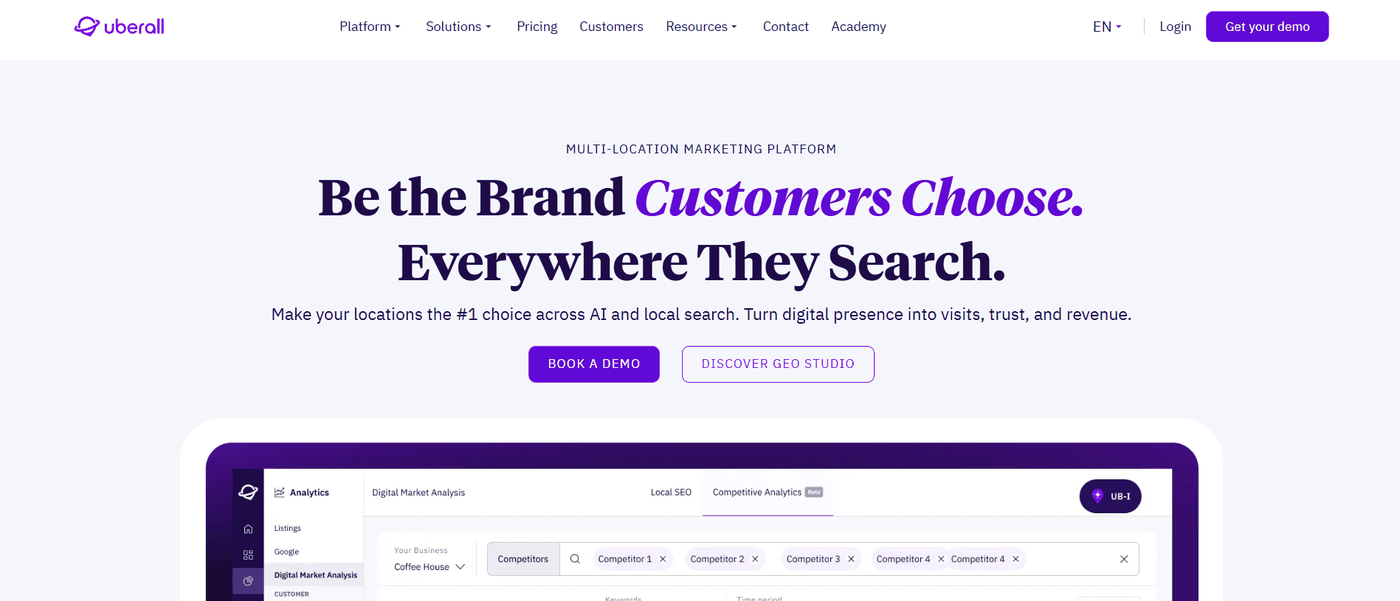
Best fit: Large multi-location brands that want business-information management, bulk updates and duplicate controls inside a broader location-marketing platform.
Uberall’s current listings product is designed for centralized business-information management across more than 150 supported directories, including major platforms such as Google, Apple Maps, Yelp and Bing. The platform supports multi-location updates, giving teams a way to change addresses, phone numbers, hours, or other location details centrally rather than editing each destination separately.
For NAP drift, Uberall combines distribution with duplicate identification and location-data controls. Its franchise and multi-location materials describe bulk editing, profile protection and duplicate suppression, which can be useful where incorrect data affects many branches at once.
Uberall markets synchronization as fast, but, as with other listing platforms, the final public state can depend on the receiving publisher. Buyers should therefore use the software’s status reporting together with direct checks of priority consumer listings.
Pricing for the broader listings packages is sales-led rather than presented as one universal per-location public rate.
Limitation: Businesses that need only a one-time citation cleanup may not need the broader multi-location feature set.
Consider Uberall if: you operate a large, distributed network and want listings accuracy combined with ongoing multi-location administration.
Which Listings Should You Fix First?
Do not prioritize by alphabetical directory name.
Use customer impact.
Fix Immediately
Wrong primary phone numbers, incorrect map pins, closed locations shown as open, former addresses on major maps, unauthorized duplicates and materially incorrect business names deserve the fastest response.
Fix Next
Wrong URLs, primary categories, ordinary hours, high-visibility industry directories and outdated records that rank for brand searches belong in the next queue.
Fix During the Normal Cleanup Cycle
Secondary directory records, suite formatting differences and low-visibility citations can follow.
Do Not Waste the Project on Cosmetic Differences
Street versus St. should not consume the same operational attention as a disconnected phone number.
This severity-based method also appears in the multi-location listing checklist, which recommends separate Critical, High, Medium, and Low queues rather than treating every discrepancy as equally urgent.
How Do You Verify That NAP Drift Is Actually Fixed?
Verification should happen outside the listings-management platform.
Open an incognito browser or signed-out search session where practical and search for:
- the current business name,
- former business name,
- current phone,
- old phone,
- current address,
- former address,
- brand + city,
- brand + street.
Then inspect the actual public profile.
Do the same in the major map products.
For every corrected record, mark four separate dates:
Found: when the discrepancy was detected.
Submitted: when your team sent the correction.
Live: when the new information first appeared.
Verified: when somebody manually confirmed it.
That distinction gives you real time-to-fix reporting.
If you only record “submitted,” your local listings KPI will look healthier than customers’ actual experience.
Can NAP Drift Be Permanently Fixed?
You can dramatically reduce it, but a “one-and-done forever” promise is unrealistic.
Business information keeps changing.
Customers can suggest edits. Employees can create profiles. Franchise locations can change hours. Companies move. Publishers can refresh data from other sources.
The better goal is controlled drift.
A strong operating model includes:
One approved record per location. All outward updates begin there.
Named field owners. Someone owns names, addresses, phones, hours and status.
Change logs. Record who changed a field and why.
Controlled profile access. Former employees and agencies should not retain unnecessary permissions.
Monthly spot-checks. Review primary consumer platforms.
Quarterly full audits. Search the broader directory footprint and duplicates.
Immediate trigger audits. Run an extra pass after a move, rebrand, phone change, acquisition, opening or closure.
The 2026 listing-management checklist recommends the same combination of monthly checks, quarterly deeper audits and immediate event-driven reviews.
How Often Should Businesses Audit NAP Consistency?
For a stable single-location business, quarterly checks may be enough if business information rarely changes.
For franchises, healthcare groups, retailers and other multi-location organizations, monthly sampling is more practical.
A useful schedule is:
| Situation | Audit cadence |
|---|---|
| Stable single location | Quarterly |
| Business with frequent hours changes | Monthly |
| Multi-location brand | Monthly sample + quarterly full audit |
| Major holiday period | Before and after the hours update |
| Relocation | Immediately, then 1, 4 and 8 weeks |
| Rebrand | Immediate full audit |
| Phone-number migration | Immediate full audit |
| Opening/closure wave | Immediate affected-location audit |
There is no Google rule requiring exactly this schedule. It is an operating cadence designed to catch problems before they remain public for months.
Why Local Listings Cleanup Sometimes Appears “Finished” Too Early
There are three different finish lines.
Technical finish: Your team submitted every planned correction.
Publisher finish: The directories accepted and published the changes.
Operational finish: You verified the changes and confirmed that old data is no longer resurfacing.
The third is the one that matters.
If an agency sends 200 updates on Monday and reports the NAP project “completed” on Tuesday, it is reporting task completion rather than business-information accuracy.
A more useful report would say:
200 corrections submitted, 151 verified live, 32 still processing, 11 awaiting ownership, 6 duplicates escalated.
That tells the business what customers can actually see.
Does Fixing NAP Drift Guarantee Higher Local Rankings?
No.
Google says accurate and complete information helps businesses appear for relevant searches, but it also clearly identifies relevance, distance, and prominence as the main local ranking considerations.
Cleaning NAP should therefore be treated as business-information hygiene and local search infrastructure, not a guaranteed ranking tactic.
A corrected phone number can stop lost calls even if rankings never change.
A corrected address can stop customers driving to the wrong building.
A closed duplicate can stop reviews being split between two profiles.
Those are valid reasons to fix NAP drift without attaching an invented ranking percentage to the project.
Frequently Asked Questions
How Long Does It Take to Fix NAP Inconsistencies?
Simple edits on directly controlled profiles may resolve within hours or several days. Broad citation cleanup usually needs longer. A practical project window is about two to eight weeks for many businesses, with complex duplicates, ownership issues and large multi-location migrations potentially taking longer. Platform-specific timings vary.
What Is NAP Drift in Local SEO?
NAP drift is the gradual development of inconsistent business names, addresses and phone numbers across maps, search engines, directories, and other public sources. It commonly develops after moves, rebrands, phone changes, ownership transfers and years of separate listing edits.
How Long Does Google Business Profile Take to Update?
Google says profile edits usually take up to 10 minutes to review, but some can take up to 30 days.
How Long Does Citation Cleanup Take?
Manual directory updates can take several weeks because directories use different moderation and publication processes. BrightLocal, for example, says its manual submissions can take one to six weeks to become live depending on the directory.
Why Does My Old Business Address Keep Showing Online?
A legacy directory, duplicate profile, data feed, old location page or another public source may still contain the former address. Fixing only the most visible listing does not necessarily correct every source that can republish business information.
Can NAP Drift Return After It Has Been Fixed?
Yes. Business information can change through user suggestions, publisher updates, old data sources, staff edits and new duplicates. Ongoing audits reduce the likelihood that those changes remain unnoticed.
Does NAP Consistency Directly Affect Google Rankings?
Google says complete and accurate business information can help a Business Profile appear in relevant searches, but Google does not publish a standalone NAP-consistency ranking score. Its documented local-ranking factors are relevance, distance, and prominence.
How Do You Fix NAP Drift Across Hundreds of Locations?
Maintain one master record for every location, assign permanent store IDs, correct critical platforms first, use bulk listing tools where appropriate, create an exception queue and audit a representative sample monthly. Run a full audit after major network-wide changes.
Which Directories Should Be Corrected First?
Start with platforms customers actively use to find, call, or navigate to the business. For most US businesses, that means Google, Apple, Bing, and Yelp, followed by high-value industry and regional directories. Broader citation cleanup can follow.
How Often Should Local Listings Be Audited?
Monthly sampling and quarterly deeper audits work well for active multi-location businesses. Run immediate audits after relocations, rebrands, phone changes, ownership changes, openings, or closures.
Final NAP Cleanup Checklist
Fixing NAP drift is a process, not a single sync command.
Start by defining the correct business information. Audit the major consumer platforms. Correct Google, Apple, Bing, Yelp and important vertical directories first. Then work through legacy citations, data sources and duplicates. Keep every unresolved discrepancy in a tracked queue until somebody verifies the public result.
For a normal project, expect the first visible corrections to happen quickly and the full cleanup to take several weeks. Google may approve an ordinary edit in minutes, Yelp commonly reviews suggested updates within 24 to 48 hours, and connected listings software can distribute information quickly. Long-tail directories, duplicate suppression, ownership problems and legacy records are what extend the timeline.
Most importantly, do not measure success by how many updates were sent.
Measure how many locations now match the approved business record, how many critical discrepancies remain open, and how long it takes your team to correct them.
For ongoing management after the cleanup, use the 2026 Local Listing Management Checklist. For software selection, see the Best Local Listings Management Tools in 2026.