Best Local Listings Management Software in 2026: Synup vs Yext, Uberall, Birdeye & More
The best local listings management software depends on how many locations you manage and whether you need continuous synchronization, citation building, reputation tools, or broader local SEO workflows. Synup is a strong fit for agencies and multi-location teams that want listings, duplicate suppression, bulk changes, automation, and reporting in one system. Yext and Uberall lean enterprise, Birdeye combines listings with reputation, BrightLocal emphasizes citation work, and Semrush Local connects listings with a wider SEO toolkit.
Local listings management keeps business information accurate across search engines, maps, directories, and review sites. Google advises businesses to keep Business Profile information complete and current; its local results are mainly based on relevance, distance, and prominence. Listings software cannot guarantee rankings, but it can reduce the operational work of maintaining business data at scale.
Quick comparison
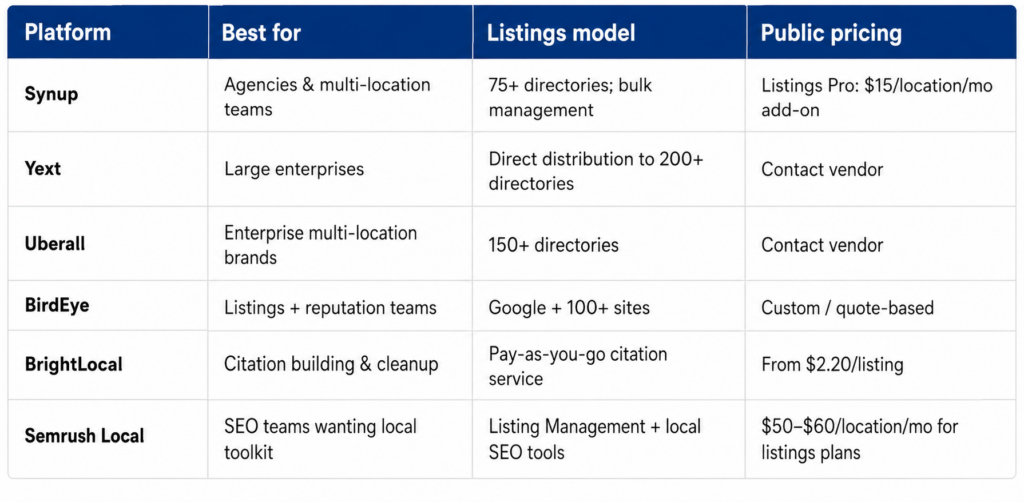
How we compared the tools. We focused on platforms that genuinely support local listings management and compared them on distribution, bulk updates, duplicate handling, local SEO or reputation features, multi-location fit, and publicly visible pricing where available. Pricing models are not directly equivalent, so use the table as orientation rather than a strict cost ranking.
1. Synup
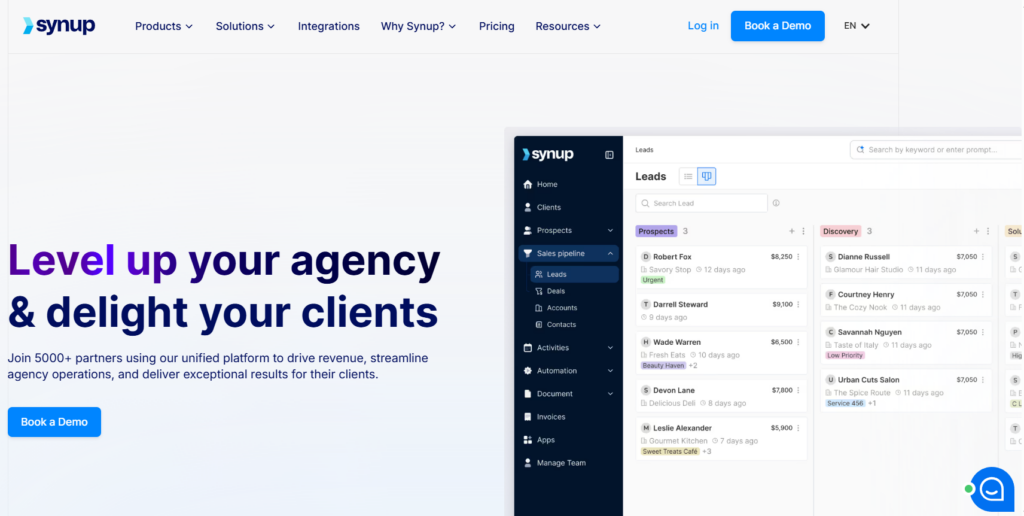
Best for: Agencies and multi-location teams that want listings management plus broader local marketing workflows.
Synup combines local listings management with agency and multi-location workflows. Listings Pro currently supports 75+ directories, bulk connections and edits, duplicate suppression, automated indexing, local posting, profile automations, campaigns, and search share-of-voice benchmarking. It is built for teams that need ongoing location management rather than one-time citation submission.
Pricing: Listings Pro is listed at $35 per location per month as an add-on to Synup OS plans. Synup OS itself has separate agency plan pricing.
Important consideration: Synup makes the most sense when ongoing management, automation, and multi-client or multi-location operations matter. A single-location business needing only a few one-time citation submissions may not need the full workflow.
2. Yext
Best for: Large enterprises that want broad publisher distribution and centralized structured business data.
Yext Listings centralizes business information across a large publisher network. Yext currently states that it supports 200+ online directories. Its broader platform is aimed at organizations managing structured information across many locations, making it most relevant to enterprise teams with complex data and governance requirements.
Pricing: Yext does not present a simple, directly comparable per-location public price on its primary Listings page; buyers should request current pricing for their use case.
Important consideration: Yext can be a strong enterprise fit, but smaller teams should evaluate whether they need the breadth and platform scope that come with an enterprise-oriented system.
3. Uberall
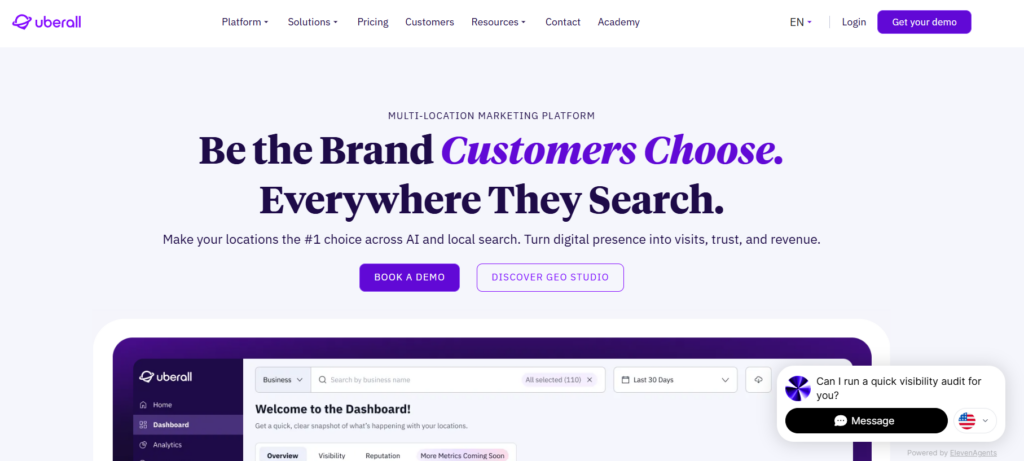
Best for: Enterprise and multi-location brands that want listings as part of a broader location-marketing stack.
Uberall Listings Management synchronizes business information across 150+ directories, including Google, Apple Maps, Yelp, and Bing. It is positioned for multi-location brands and combines centralized location data with broader location-marketing capabilities, making it relevant when listings are part of a larger local customer-experience strategy.
Pricing: Uberall primarily uses a sales-led pricing model, so businesses should contact the vendor for a current quote.
Important consideration: Uberall is best evaluated as an enterprise location-marketing platform rather than as a low-cost citation service. Teams with simpler needs may prefer a narrower tool.
4. Birdeye

Best for: Multi-location businesses that want listings management closely connected with reputation management.
Birdeye Listings AI connects listings with Birdeye’s wider reputation platform. Birdeye says it audits and updates profiles on Google and 100+ sites while supporting more than basic NAP fields. It is particularly relevant when the same team manages listings, reviews, customer feedback, and local reputation.
Pricing: Birdeye generally uses custom, quote-based pricing for its paid platform rather than publishing a simple listings-only price that applies to every buyer.
Important consideration: Birdeye is most compelling when reputation and listings need to work together. If listings are the only requirement, compare the wider platform cost and scope carefully.
5. BrightLocal
Best for: Agencies and local SEO professionals that want citation building, cleanup, and ownership without a large recurring listings contract.
BrightLocal takes a different approach from always-on synchronization platforms. Citation Builder uses a pay-as-you-go model for manually creating and correcting citations, starting at $3.20 per listing, with lower bulk-credit pricing available. It suits agencies and stable businesses that want citation ownership and cleanup without a large recurring software commitment.
Pricing: Citation Builder starts at $3.20 per listing, or lower with bulk credits; other maintenance and aggregator options have separate costs.
Important consideration: BrightLocal’s citation model is not directly equivalent to always-on enterprise synchronization. Choose it when manual citation ownership and cleanup are the priority.
6. Semrush Local
Best for: SEO teams that want local listings management inside a broader search-marketing toolkit.
Semrush Local combines Listing Management with Google Business Profile optimization, review management, and local rank tracking. Its Listing Management feature distributes and maintains business information across directories. The main advantage is consolidation for teams already using Semrush for SEO research, reporting, and competitive analysis.
Pricing: Semrush Local currently lists Local Essentials at $50 per location per month and Local Pro at $60 per location per month; the plans include Listing Management, with Pro adding API support and higher limits.
Important consideration: Semrush Local is a natural fit for SEO-led teams, but agencies or enterprises whose main challenge is complex listing governance may prefer a platform designed more specifically around location operations.
Which local listings management software should you choose?
Choose based on operating model, not brand recognition. Synup fits agencies and multi-location teams needing centralized updates, duplicate suppression, automation, and local marketing workflows. Yext and Uberall suit enterprise evaluation, Birdeye combines listings with reputation, BrightLocal focuses on citation building and cleanup, and Semrush Local fits SEO teams wanting listings inside a broader toolkit.
A simple buying framework: Locations → Update frequency → Governance → Reviews/SEO needs → Integrations → Pricing model. The more locations and frequent changes you manage, the more valuable centralized, ongoing listings management becomes.
Frequently asked questions
What is local listings management software?
Local listings management software helps businesses create, update, monitor, and correct business information across search engines, maps, directories, and other discovery platforms from a centralized workflow.
Does listings management guarantee higher Google rankings?
No. Google says local results are mainly based on relevance, distance, and prominence. Complete and accurate Business Profile information can help Google understand a business, but no listings platform can guarantee ranking improvements.
What is the difference between listings management and citation building?
Citation building focuses on creating or correcting business mentions and directory profiles. Listings management is broader and usually includes ongoing synchronization, monitoring, updates, duplicate handling, and multi-location governance.
Final takeaway
There is no single local listings management platform for every business. The right choice depends on scale, update frequency, governance, and whether reviews or broader local SEO are in scope. For agencies and multi-location operations, Synup combines 75+ directory distribution with bulk management, duplicate suppression, automation, posting, and local visibility reporting. Match the platform to the workflow you actually need.