Best Local Listing Management Software in 2026: 8 Platforms Compared
Best Local Listing Management Software in 2026: There is no single best local listing management software for every business in 2026. The right choice depends on your location count, budget, team structure, client model, and whether you need basic listings management or a broader local marketing platform. Synup and Vendasta suit agencies and resellers. Yext fits enterprises that need structured location data at scale. Birdeye puts reviews and reputation close to listings. SOCi focuses on franchises and large multi-location brands. Uberall makes sense for international location networks. BrightLocal combines listings with local SEO, while Moz Local keeps the workflow simpler for smaller businesses. Before choosing, you can also check each platform’s current G2 rating and recent customer reviews.
Local listings software now has a wider job than correcting your name, address, and phone number on a few directories. Customers find businesses through Google Maps, Apple Maps, search engines, review sites, navigation apps, social networks, and AI-powered search tools. If those sources contain conflicting information, customers may encounter the wrong address, opening hours, phone number, or business status.
That can affect real visits. Data Axle’s 2026 consumer research found that 66% of respondents had encountered incorrect business information, while 85% said inaccurate information affects whether they return to a business.
This comparison looks at eight widely used platforms and focuses on a more useful question than “Which software has the most features?”
Which platform best matches the way your business actually manages local search?
What is local listings management?
Local listings management is the process of creating, correcting, distributing, and monitoring your business information on online services that help people discover local companies.
A local listing usually contains:
- Business name
- Street address
- Phone number
- Website URL
- Opening hours
- Primary and secondary business categories
- Services
- Photos
- Business descriptions
- Location status
- Location-specific attributes
Google Business Profile receives a lot of attention, but it represents only one place where customers may find this information.
Your location data can also appear on Apple Maps, Bing, Yelp, Facebook, navigation services, vertical directories, local directories, and other discovery services.
For one location, you may be able to manage several profiles manually.
At 25 locations, that process starts consuming more time. At 250 locations, spreadsheets and separate account logins become difficult to control.
Consider a retailer that changes its Sunday opening time.
If the company operates 300 stores, staff need to know which locations changed, whether the update reached the right publishers, whether old information remains elsewhere, and whether regional managers made conflicting edits.
A listings management platform centralizes much of that work.
Depending on the software, you may be able to:
- Edit location information in bulk
- Send data to third-party publishers
- Find inconsistent information
- Manage duplicate profiles
- Monitor listings after publication
- Track citations
- Manage customer reviews
- Monitor local rankings
- Control access for local managers
- Manage several client accounts
- Produce client reports
- Offer branded or white-label services
The exact feature set matters less than whether the platform supports your operating model.
A five-location law firm does not need the same controls as a 2,000-location franchise. An SEO agency managing 70 unrelated businesses also needs a very different account structure.
AI-powered local search has added another consideration.
Yext now explicitly positions its listings product around distribution to directories and AI services, including ChatGPT and Gemini, and says its network covers more than 200 publishers, directories, and LLMs.
Your task remains practical. Keep accurate business information in the places people and search systems use to understand your locations.
The 3 types of local listings platforms
You can simplify the market by separating local listings software into three broad categories.
Some platforms overlap. Still, these groups help you avoid comparing products that solve noticeably different problems.
1. Listings-first platforms
Listings-first tools concentrate on managing and distributing location data.
Yext and Uberall fit this category closely. Moz Local also suits buyers looking for a more focused listings workflow.
These products make sense when your primary requirement sounds like this:
“We need accurate location information published consistently and managed centrally.”
Yext currently supports business listing management across more than 200 online directories and connects listings with its structured-data products.
Uberall also centers its product around multi-location visibility. Its current packages start with an Essentials offering and add listings, reviews, social, and other functions depending on the package selected.
A listings-first product can suit your business when location data creates more work than reviews, social publishing, or client marketing services.
2. Listings plus local SEO platforms
This category combines listings management with tools that help SEO teams measure and improve local search performance.
BrightLocal represents this model well.
Its platform includes listings management, local rank tracking, citation tools, reputation functions, and local SEO reporting. BrightLocal’s current platform pricing starts at $39 per month, while its separate citation-building service starts at $2 per citation.
That difference matters for agencies.
Your client may care that you corrected 30 citations, but the next question will probably involve search visibility.
They may ask:
- Where do we rank?
- Which locations lost visibility?
- Which competitors appear above us?
- Which citations are missing?
- Are our Google profiles performing differently?
- Which local SEO problems should we fix next?
If your team needs to answer those questions regularly, a listings and SEO platform can fit better than a pure distribution product.
3. Multi-location marketing and agency platforms
The third category treats listings as one part of a larger marketing workload.
Birdeye, SOCi, and Vendasta fit here, although they target different users.
Birdeye combines location visibility with reviews, reputation, and other multi-location marketing functions. Its current pricing uses a custom model based on products, location count, and contract structure.
SOCi focuses on large multi-location and franchise organizations. Its current product positioning includes local search, social media, reviews, and listings.
Vendasta serves agencies, resellers, and service providers. Its plans include local SEO and listing sync alongside client-facing tools, reporting, and a broader collection of products agencies can resell.
Choose this type of platform when your listing work sits beside other responsibilities that your team already manages.
3 local listings myths to drop in 2026
Myth 1: Google Business Profile is the only listing you need to manage
Google deserves priority, but relying on one profile creates blind spots.
A customer might find your company through Google and then use Apple Maps for directions. Someone else may check a review site before visiting. Another person may ask an AI assistant for nearby options.
Your business information needs to agree where those searches happen.
Data Axle found that incorrect business information already affects large numbers of consumers. Its 2026 research reported that 66% of consumers had encountered incorrect business data.
You do not need to chase every obscure directory you can find.
Prioritize the services your customers use, your primary map providers, major search platforms, and industry-specific directories that influence purchase decisions.
Myth 2: The platform with the most directories must be the best
Directory count gives you useful context, but it should never make the decision for you.
Yext currently states that its distribution network reaches more than 200 publishers, directories, and LLMs.
That breadth can help an enterprise with many locations and complex data requirements.
A small accounting firm with three offices may not need the same distribution model. Its more pressing needs could involve easy updates, manageable cost, and a simple workflow.
Ask each vendor to show you its publisher network for your market.
Then ask:
- Which publishers receive data directly?
- Which sites matter for my industry?
- Which countries receive coverage?
- How quickly do updates normally appear?
- What happens when a directory changes my information?
- How does the software treat duplicate profiles?
Relevant coverage beats an impressive number with little connection to your customers.
Myth 3: Listings management ends once your information is correct
Business data changes.
You may open a new branch next month. A store may move. A restaurant may change its weekend hours. A phone number can change. A franchisee may edit a profile without telling corporate marketing.
The software should help you manage those changes after the initial cleanup.
This becomes especially difficult at large location counts. SOCi’s 2026 material on managing 100 or more locations describes inconsistent data and difficult updates as common problems when teams lack central control.
During a product demo, do not spend the entire time looking at dashboards.
Give the vendor a task.
Ask the salesperson to show you how an administrator would change holiday hours for 75 locations, correct five wrong telephone numbers, or close one location without affecting others.
That tells you how the platform will work on a busy Monday morning.
The 8 platforms compared
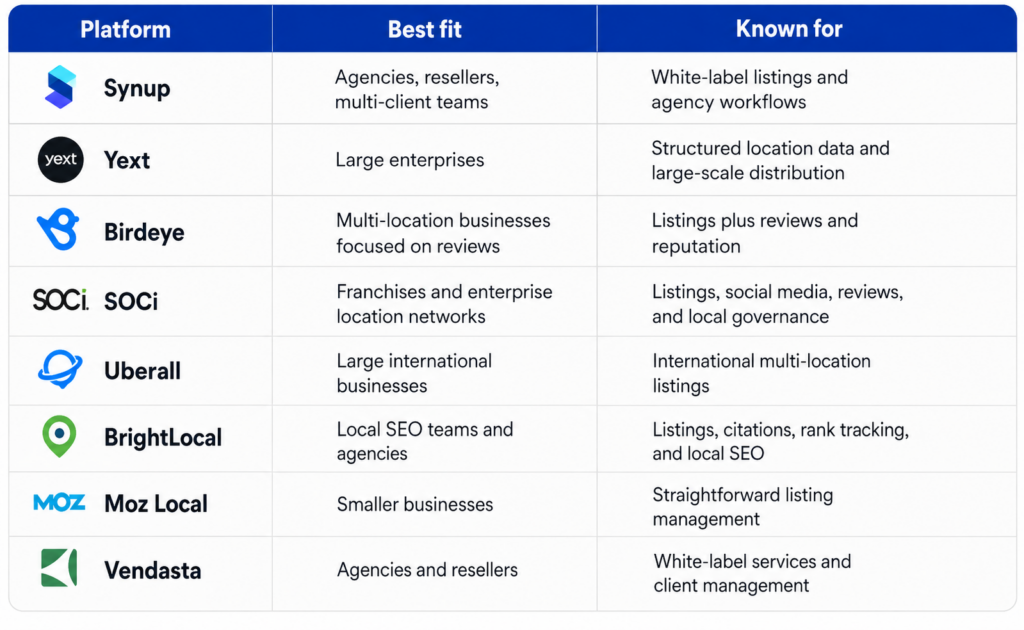
**
Q: What is the best local listing management software in 2026?**
A: No single product fits every business. Synup and Vendasta suit agencies and resellers, while Yext fits enterprises that need structured location-data management. Birdeye works well when reviews create much of your workload, SOCi suits franchise governance, and Uberall fits larger international location networks. BrightLocal works well for teams that need listings and local SEO tools together, while Moz Local offers a simpler option for smaller businesses.
1. Synup
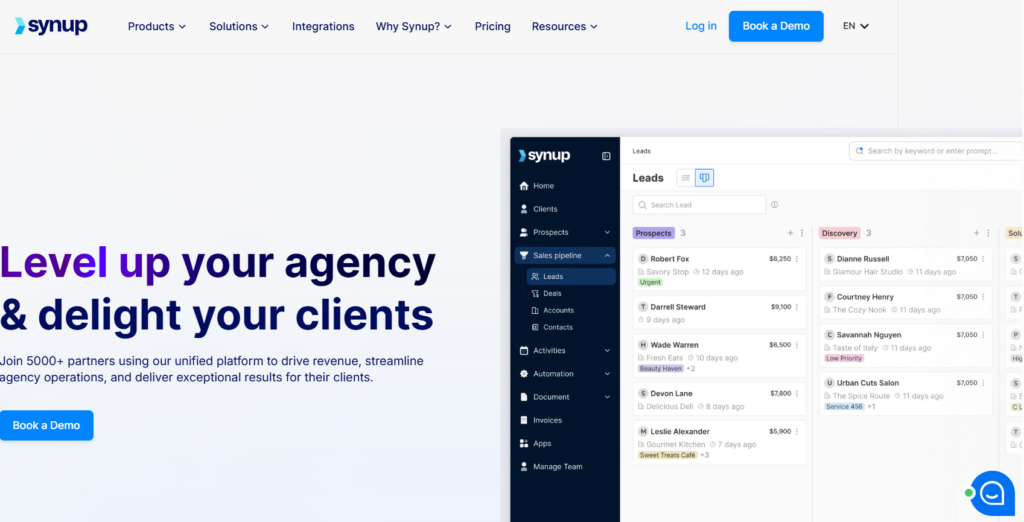
Best for: Agencies, resellers, and teams managing many client accounts
G2 rating: 4.5/5, based on 315 reviews at the time of our check.
Pricing: Starts at $79/month when billed annually or $99/month when billed monthly.
Synup makes the strongest case when you manage local presence for other businesses rather than only your own locations.
Its current plans make that agency focus clear.
The Startup plan costs $79 per month with annual billing and includes up to 25 client accounts, five team members, listings management for 25 locations, review management for 25 locations, and API access. The Agency plan costs $199 per month annually and expands listings and review management to 100 locations. Scale costs $799 per month annually and covers up to 500 locations.
Synup also offers white-labeled emails and agency-oriented account controls.
That structure helps an agency turn listings into a repeatable service.
Instead of opening separate systems for every client, your team can work inside a central account structure. The API also matters if you want to connect listing data with your own reporting or internal systems.
The limitation is equally clear.
If you own three physical locations and have no agency clients, much of Synup’s account-management structure may go unused.
Choose Synup when: You run an agency or reseller operation and want a listings platform designed around multiple clients, scalable location limits, APIs, and branded delivery.
2. Yext
Best for: Enterprises with large and complex location-data requirements
G2 rating: 4.4/5, with more than 1,100 reviews at the time of our check.
Pricing: Custom enterprise pricing. Yext does not display a simple public price for its primary listings platform.
Yext sits at the enterprise end of this comparison.
Its Listings product covers more than 200 online directories and now explicitly includes AI services in its location-data distribution positioning.
The more important distinction involves data structure.
Large businesses rarely manage only an address and phone number.
A national retailer might need to control hours, store services, departments, accessibility details, local URLs, photos, categories, and other attributes for hundreds or thousands of locations.
When those records live in separate spreadsheets or business systems, keeping them synchronized becomes difficult.
Yext’s structured-data approach suits businesses where controlling the underlying information creates as much work as distributing it.
G2 reviewers often praise its listings reach and centralized management, although G2 also identifies a learning curve in user feedback.
That tradeoff makes sense for the buyer profile. More control can mean more setup and training.
Choose Yext when: You manage a large location network and need a central structured-data layer that can feed listings and other search experiences.
3. Birdeye

Best for: Multi-location businesses where reviews and reputation create a large share of the workload
G2 rating: 4.7/5, based on more than 4,100 verified reviews.
Pricing: Custom. Birdeye says pricing depends on the products selected, location count, and contract structure.
Birdeye makes more sense when listings form one part of a larger reputation-management job.
Its multi-location product positioning combines location visibility, review management, customer communication, and related marketing functions.
Consider a healthcare network with 120 clinics.
Correct addresses and office hours matter, but the marketing team may also receive hundreds of patient reviews every month. Staff need to monitor those reviews, respond consistently, identify locations that need attention, and maintain accurate profiles.
A focused listings platform handles only one part of that workload.
Birdeye gives that type of organization a broader set of tools.
G2 reviewers frequently mention centralized review management and the ability to handle feedback for several locations in one place.
The broader product scope may be unnecessary if you mainly need citation cleanup and simple directory distribution.
Choose Birdeye when: Reviews, reputation, and listings all require ongoing attention, especially when you manage several locations.
4. SOCi
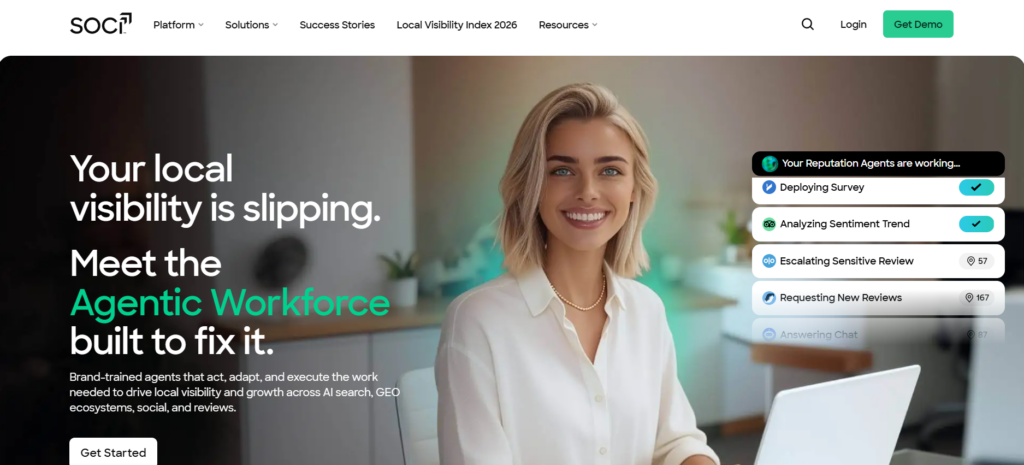
Best for: Franchises and large multi-location companies that need central brand controls
G2 rating: Around 4.5/5 on current G2 review results.
Pricing: Custom. SOCi targets enterprise and multi-location organizations rather than publishing a standard self-service listings price.
SOCi addresses a problem that becomes obvious in franchise organizations.
Corporate teams want consistency. Local teams still need enough access to manage location-level marketing.
If every franchisee can freely change business information and social content, brand control becomes difficult. If corporate teams lock down everything, local marketing teams lose the ability to respond to their markets.
SOCi combines local search, listings, reviews, and social media for enterprise brands. Its site currently says more than 1,000 enterprise brands use the platform.
Recent G2 feedback also describes centralized multi-location management and brand consistency as strengths for franchise use cases.
That makes SOCi different from software that focuses almost entirely on citations.
If your company has 200 franchise locations and corporate marketing needs to control listings, social content, and reputation processes, SOCi deserves a serious comparison.
If you have six independently managed branches and only need listing synchronization, the product may cover more ground than necessary.
Choose SOCi when: Your franchise or enterprise team needs listings management alongside local social media, reviews, and corporate governance.
5. Uberall
Best for: Large international and multi-location businesses
G2 rating: 4.4/5, based on 237 reviews at the time of our check.
Pricing: Custom for the main multi-location platform. Uberall publishes package information but does not show a standard dollar price for its core listings packages.
Uberall deserves more attention when your organization operates in several countries.
International listings management creates additional questions.
Which directories matter in Germany? What about France, Australia, or the UK? Can you update location groups by region? How do you handle a company with hundreds of locations and different regional requirements?
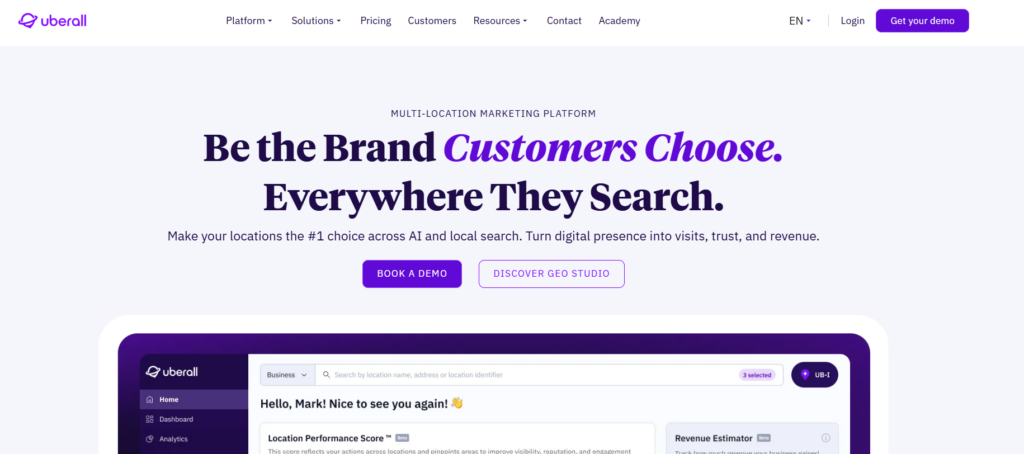
Uberall positions itself around multi-location marketing and local digital presence across listings, reviews, social media, local pages, store locators, and AI search visibility.
Its pricing page currently organizes the product into packages rather than publishing a simple per-location dollar rate.
G2 users give Uberall an average score of 4.4/5, and current G2 summaries frequently mention centralized management and ease of use.
This makes Uberall more suitable for a multinational retailer than a local business with four branches in the same city.
Choose Uberall when: You operate a large location network and international coverage forms an important part of your requirements.
6. BrightLocal
Best for: Local SEO agencies, consultants, and businesses that need listings plus search analysis
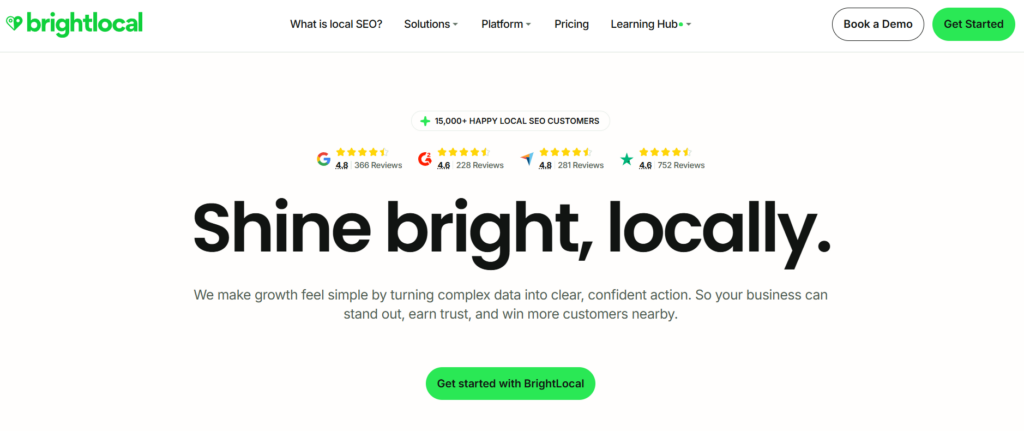
G2 rating: 4.6/5, based on 229 reviews.
Pricing: Starts at $39/month. BrightLocal also offers custom plans for larger organizations.
BrightLocal approaches the problem differently.
It treats listing management as part of a broader local SEO workflow.
Its platform combines rank tracking, listings management, citation tools, and reputation functions. BrightLocal also offers Citation Builder separately, starting at $2 per citation.
That separation can work well for agencies because clients rarely have identical requirements.
One client may need a citation cleanup project. Another may need ongoing listings management. A third may require local rank tracking and regular SEO reporting.
BrightLocal gives local SEO teams several tools within the same product family.
The platform can make particular sense for businesses managing roughly 5 to 50 locations, where you need more reporting and search data than a basic listings product provides but may not need a large enterprise data platform.
G2 currently gives BrightLocal 4.6/5, with 229 reviews.
Choose BrightLocal when: Your team needs listings management, citation work, and local SEO measurement in the same working environment.
7. Moz Local
Best for: Smaller businesses with simpler listings requirements
G2 rating: 4.2/5, based on 475 reviews.
Pricing: G2 currently lists Lite at $16/month, Preferred at $24/month, and Elite at $33/month.
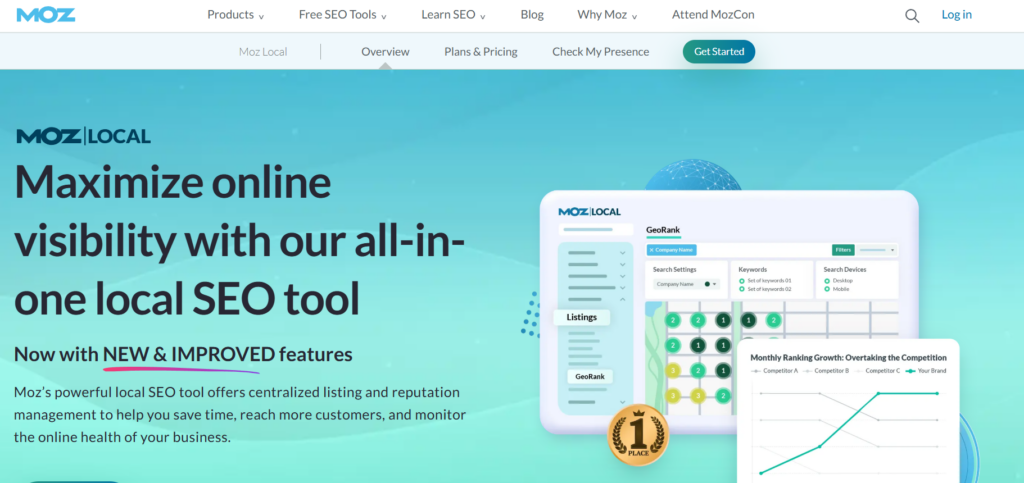
Moz Local makes sense when you want to avoid enterprise complexity.
A business with three locations may simply need accurate listings, fewer manual updates, and an easier way to keep basic location data consistent.
It probably does not need extensive franchise permissions, white-label client accounts, international governance, or a large reputation-management suite.
That simpler buyer profile also appears in G2 feedback, where Moz Local frequently appears as an option for local businesses and smaller organizations.
The publicly surfaced G2 pricing also sits below many broader multi-location platforms. G2 currently shows $16 per month for Lite, $24 for Preferred, and $33 for Elite.
Because those figures come from G2 rather than a current Moz pricing page found during our check, confirm the final price and plan terms with Moz before buying.
Choose Moz Local when: You manage fewer locations, want a straightforward listings workflow, and do not need the wider operational controls found in enterprise products.
8. Vendasta
Best for: Agencies and resellers that want listings inside a broader client-service platform
G2 rating: 4.5/5, with more than 500 reviews.
Pricing: The current Starter plan has a $99 monthly minimum, Professional has a $499 monthly minimum, and Premium has a $999 monthly minimum.
Vendasta competes for many of the same agency buyers as Synup, but it takes a broader approach.
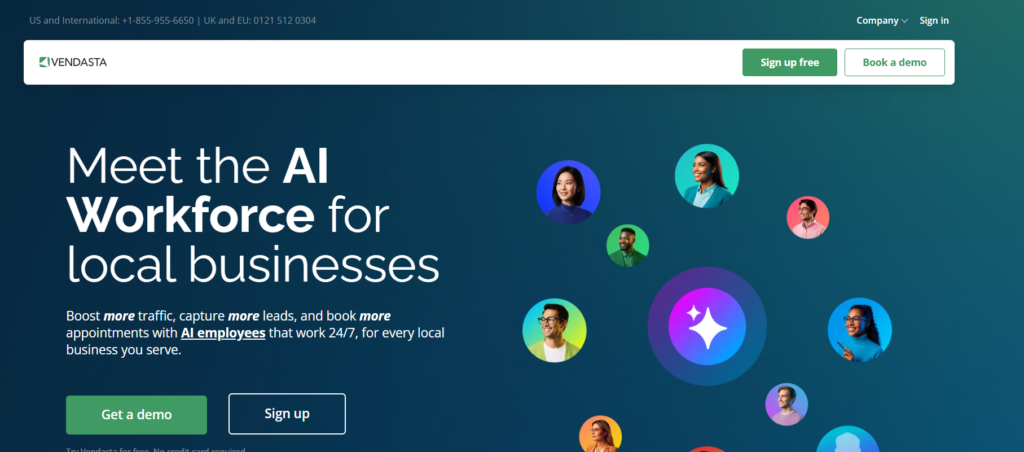
Its platform supports agencies that sell several digital products and services to local businesses. Local SEO and Listing Sync sit alongside client portals, reporting, reputation products, social tools, and other agency functions.
Its pricing model needs a little explanation.
Vendasta currently lists a $99 monthly minimum for Starter, $499 for Professional, and $999 for Premium. Qualifying Vendasta product spending can count toward that minimum, which means the effective platform subscription charge can fall to zero when qualifying product spend meets the required amount.
Professional includes a white-label client portal, while Premium targets larger teams and multi-location clients.
This structure works best when you plan to use Vendasta as more than a listings utility.
If you sell reputation management, local SEO, listings, social services, and other products, keeping those services in one agency platform can simplify client administration.
If listings represent your only requirement, compare the total cost and workflow carefully against Synup and BrightLocal.
Choose Vendasta when: You run an agency and want listings to sit inside a wider platform for selling and managing several client services.
Which platform fits which buyer?
Use this framework to reduce the shortlist quickly:
- Under 5 locations, tight budget: Moz Local. Its simpler workflow and lower publicly listed pricing make more sense when you do not need enterprise controls.
- 5 to 50 locations, need listings and SEO together: BrightLocal. You get local SEO measurement and citation tools alongside listing management.
- 50+ locations, enterprise: Yext or Uberall. Choose Yext when structured location data and broad distribution dominate your requirements. Give Uberall extra attention when international coverage matters.
- Agency managing multiple clients: Synup, Vendasta, or BrightLocal. Synup focuses closely on agency listings workflows. Vendasta covers a broader client-service model. BrightLocal suits agencies that want local SEO tools beside listings.
- Reviews are the main pain point: Birdeye. Its broader reputation-management focus fits organizations where review work consumes considerable staff time.
- Franchise with social media governance needs: SOCi. Its combination of local search, listings, reviews, and social controls suits franchise organizations with corporate and local teams.
- International multi-location network: Uberall. Its product positioning centers on larger location networks and multi-country local visibility.
- Complex enterprise location data: Yext. Its structured-data approach fits companies that manage substantial amounts of location information.
Once you narrow the market to two or three products, read their current G2 reviews.
Do more than compare star ratings.
Filter reviews by company size where possible. Pay attention to reviewers managing a location count similar to yours. Look for repeated comments about setup, customer support, bulk updates, reporting, pricing, and usability.
A 4.7/5 product can still be wrong for your operating model. A lower-rated product may fit your specific workload better.
Why accurate listings matter
Listing accuracy affects customers before they reach your website, call your staff, or enter your location.
Data Axle’s 2026 study surveyed 1,000 U.S. consumers and found a clear relationship between inaccurate information and customer decisions.
- 66% had visited or tried to visit a business only to discover incorrect online information.
- 85% said incorrect or outdated information affects whether they visit again.
- 87% said they are likely to choose a business with more accurate and complete information.
Those percentages become easier to understand when you consider what an error looks like in practice.
A customer checks Google Maps and sees that your store closes at 8 p.m. They arrive at 7:20 p.m., but the store actually closed at 7.
Another customer taps a phone number from an old directory profile and reaches a disconnected line.
Someone searching for a medical clinic follows an outdated address after the practice moved.
The marketing problem becomes a customer-service problem immediately.
AI search adds another reason to maintain consistent business records. Yext now distributes listings data with AI services specifically in mind, and Uberall includes AI search visibility within its multi-location offering.
You can audit your own location data without buying software first.
Pick five locations and search each one on:
- Google Maps
- Apple Maps
- Bing
- One relevant industry directory
- One AI search service
Record the name, address, telephone number, hours, URL, and location status.
If those details disagree, investigate where the incorrect information originates before rolling out a larger listings program.
Local listings software buying checklist
- **Count your current and planned locations.**Do not buy only for today’s business. If you have 20 locations and expect to reach 60 next year, test how the software works at 60.
- **List the publishers that actually matter.**Ask vendors for their publisher list in your country. Check Google, Apple, Bing, relevant navigation services, review sites, and industry-specific directories.
- **Decide whether you need listings only.**You may need citation analysis and rank tracking, which favors a product such as BrightLocal. Reviews may dominate your workload, which makes Birdeye more relevant. Franchise controls may point toward SOCi.
- **Test bulk editing during the demo.**Ask the salesperson to change holiday hours for 50 sample locations. Watch how many screens, approvals, and manual steps the task requires.
- **Check client and user permissions.**Agencies need separate client accounts. Franchises may need corporate administrators plus local users. Ask exactly what each permission level can edit.
- **Ask what happens after publication.**Find out how the software handles duplicate records, third-party edits, closed locations, publisher errors, and information that falls out of sync.
- **Compare the real cost at your location count.**Public entry prices can be misleading if you manage hundreds of locations. Request quotes using the same number of locations, users, services, and contract period.
- **Read G2 reviews that resemble your business.**Filter for company size and use case. One-location reviewers may tell you little about a nationwide rollout.
Final takeaway
The best local listing management software in 2026 depends on how many locations you manage and what your team needs to do besides updating listings. Start with buyer fit, narrow the market to two or three platforms, then compare real workflows, current G2 feedback, publisher coverage, and pricing at your actual location count.