
The best local listings management platforms for franchises in 2026 are BrightLocal, Synup, and Uberall. None is a default pick for every network. BrightLocal fits franchise teams that need audits, rank tracking, and citation work with listing sync on key sites. Synup fits franchise and agency teams that need listings, reviews, and white-label operations on a published location-band price. Uberall fits larger networks that need listings, reviews, and local social under role-based control. Choose by location count, corporate versus franchisee control, update frequency, reviews and listings ownership, integrations, and budget.
Local listings platforms compared
These products are not interchangeable. A franchise that needs geo-grid audits is not buying the same job as a franchise that needs 400 units kept in sync when a new store opens. Confirm current pricing with each vendor. Public rates below are from official pages as of August 2026.
| Platform | Best For | Key Strength | Pricing |
|---|---|---|---|
| BrightLocal | Franchise teams that audit and measure local SEO | Rank tracking, citations, GBP audits, key-site sync | From $41/mo (1 location) |
| Synup | Franchise and agency teams running listings plus reviews | 100+ publishers, reviews, white-label on Premium+ | From $49/mo (1 location) |
| Uberall | Larger franchise networks needing governed local presence | 150+ directories, reviews, local social, permissions | Custom / Contact vendor |
How we evaluated these platforms
We compared BrightLocal, Synup, and Uberall as working software for franchise networks, not as a ranked awards list. Criteria: corporate versus franchisee permissions, brand-name and NAP consistency, bulk location updates, duplicate handling when new units open, review workflows and response SLAs, white-label or agency delivery, publisher coverage, and whether public pricing exists. Pricing is from official pages as of August 2026. Unpublished rates are Custom / Contact vendor. No platform can guarantee Google or AI rankings.
How should a franchise choose a listings platform?
Walk this order: Location count, Corporate versus franchisee control, Update frequency, Reviews and listings ownership, Integrations, then Budget. Do not start with a vendor logo or a best-of list.
Location count. Ten units is still a practitioner problem. You can audit, fix citations, and push Google posts without an enterprise contract. One hundred units is a data-sync problem. Five hundred units is a permissions and onboarding problem. BrightLocal prices by location bands and stays useful while the work is audits plus key-site sync. Synup prices by location bands through 50 locations, then Enterprise. Uberall is sales-led and built for larger footprints.
Corporate versus franchisee control. Decide who may edit the brand name, category, phone number, hours, photos, Google posts, and review replies. Corporate-only control protects the brand and slows local fixes. Franchisee-only control speeds replies and creates NAP drift. Most networks need a split: corporate locks name, primary category, and core description; franchisees edit hours, photos, and replies inside those rules. Ask each vendor to show that split in a demo, not in a slide.
Update frequency. If hours change weekly, holiday hours land four times a year, or new units open every month, you need a system of record that publishes once and tracks acceptance. If profiles are stable, a tracker plus a citation campaign may be enough. A pizza franchise that changes hours after a storm is not the same buyer as a tax franchise that updates once a season.
Reviews and listings ownership. Some brands want corporate to own every Google Business Profile and every directory login. Some brands let franchisees own the profile and only ask HQ for reporting. Ownership decides who can suppress a duplicate, who can accept a suggested edit, and who is on the hook for a 24-hour review SLA. If franchisees own the listings, pick a platform they will actually log into. If corporate owns them, pick a platform that can bulk-edit without waiting on each owner.
Integrations. Map the stack you already run: POS or franchise management software, CRM, review widgets, agency reporting, and store-locator pages. BrightLocal exposes APIs and an MCP server on higher plans. Synup publishes APIs and MCP support and is built for agency and platform resale. Uberall lists 50+ integrations and MCP access to location data. Do not buy a listings tool that cannot talk to the system that already stores your addresses.
Budget. Public starting points help you model a 10-location or 25-location network. Enterprise quotes do not. Treat third-party from-X per location figures for Uberall, Yext, or SOCi as unverified. Ask for a quote that states location count, modules, contract term, and who pays: corporate, franchisee, or a split.
A 12-unit home-services franchise that updates hours twice a year and wants monthly rank reports is a different buyer than a 200-unit QSR that opens 20 stores a year and needs duplicate suppression on day one. Use the six questions above before you book demos.
BrightLocal
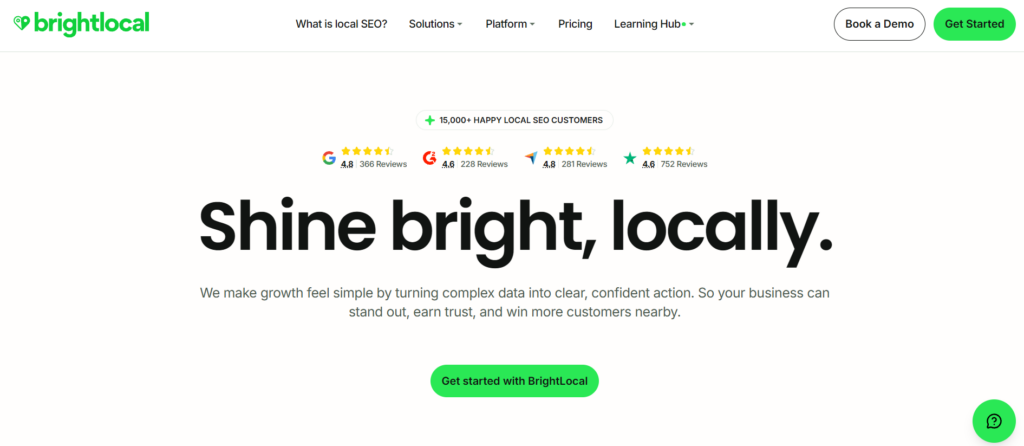
Best for: Franchise marketing teams and the agencies that support them when the job is local SEO diagnosis, rank tracking, citation work, and listing control on the sites customers actually use.
What it does: BrightLocal is a practitioner-focused local SEO platform that measures pack and map visibility, finds citation gaps, audits Google Business Profile health, and syncs core listing data on key sites. BrightLocal is built around the monthly work franchise SEO teams already do: check where each unit ranks, find the stores that are slipping, fix NAP errors, and package the result for brand or agency stakeholders.
Key capabilities:
- Local Rank Tracker and Local Search Grid for pack and map measurement, plus roll-up reports across a multi-location set
- Citation Tracker plus a pay-as-you-go Citation Builder; you own the citations after they are built
- GBP audits, Active Sync on Google Business Profile, Facebook, Apple Maps, and Bing, and a GBP Post Scheduler
- Review monitoring, response, and generation on the Grow plan
- White-label reports and a Location Summary dashboard
Franchise permissions and brand consistency: BrightLocal is strongest when a central team or agency runs the program. BrightLocal can manage hundreds of locations, bulk-upload units, schedule Google posts, and monitor reviews from one inbox. BrightLocal does not present the same corporate-versus-franchisee permission model that Uberall documents. If each franchisee needs a locked-down portal with HQ approval queues, ask BrightLocal to show that workflow. Active Sync lets a central user push categories, hours, descriptions, and attributes and alert you when an external edit lands.
Bulk updates and new-unit duplicates: When a franchise opens a new unit, BrightLocal can add the location, run citation and GBP work, and use Citation Builder to find and remove duplicate listings. BrightLocal also offers enterprise bulk-update workflows for 50-plus locations. Holiday hours and national promotions can go out through Active Sync and the GBP Post Scheduler.
Reviews and SLAs: BrightLocal Grow centralizes review monitoring and response and supports email, SMS, and in-store review requests. A franchise that sets a 24-hour reply SLA can work from one inbox. If corporate must approve every reply before it posts, confirm that workflow in a demo.
Pricing: The BrightLocal Help Center (updated 29 June 2026) lists Track at $41, Manage at $54, and Grow at $65 per month for one location. Annual billing is about 25% off. Grow for 6-10 locations is $131 per month on the same table. The marketing pricing page may show Price on request. Citation Builder starts at $2 per citation. A 14-day free trial is available.
Important consideration: BrightLocal is built for practitioner audits and measurement with listing sync on key sites. A franchise that needs 150-plus directory syndication, franchisee self-serve portals, and workflow approvals across hundreds of units will usually need Synup, Uberall, or an enterprise option instead of, or in addition to, BrightLocal.
Synup
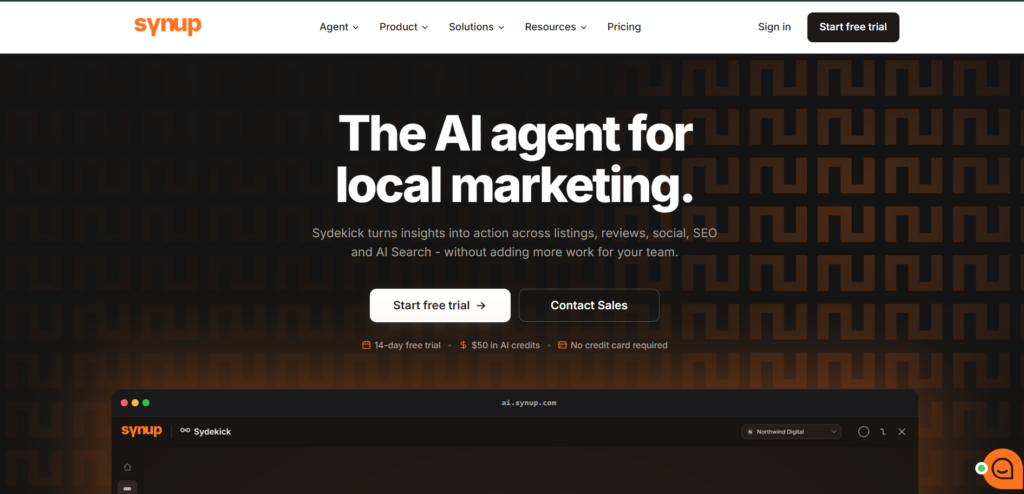
Best for: Franchise brands and the agencies that serve them when listings, reviews, reporting, and white-label delivery need to sit in one operating layer with a published location-band price.
What it does: Synup is a local presence platform that publishes business data to directories, monitors and generates reviews, tracks local visibility, and packages branded reporting. Synup is an operating layer for a portfolio: keep location facts current, watch reputation, and send reports that look like the agency or franchisor. Synup also sells a franchise solution that gives franchisees a branded portal while the franchisor keeps network visibility.
Key capabilities:
- Listings distribution across 100+ publishers in 50+ countries, including Google Business Profile, Apple Maps, Facebook, and Bing
- Review monitoring, responses, and generation, with unreplied reviews surfaced per location
- Local rank grid, visibility scoring, and NAP checks
- White-label dashboard, domain, and reports on Premium and higher plans
- Duplicate queue, scheduled holiday hours, bulk-connect of publisher logins, and connection-health alerts
Bulk updates and new-unit duplicates: A corporate user can change hours or a description and have the agent push the edit to connected publishers, then retry failures. Holiday hours can be scheduled and reverted. When a new unit opens, Synup can create the record, connect publisher logins in bulk, and group suspected duplicates by match confidence. Synup says a typical location actively syncs to roughly 65-69 of the 100+ publishers, depending on category and region.
Reviews and SLAs: Synup collects reviews against each location, drafts responses for approval, and runs review-generation campaigns. A franchise that wants a 24-hour SLA can assign franchisees to their own inbox and let HQ see unreplied items across the network.
Pricing: Public bands on synup.com/en/pricing (verified August 2026) are Solo at $49 per month for one location, Premium at $299 for up to 10, Pro at $499 for up to 25, and Scale at $899 for up to 50. Annual billing saves 20%. Enterprise is custom above 50 locations. White labeling starts on Premium. Older OS Base plus Listings Pro cards at $35 per location are stale. A 14-day free trial is offered.
Important consideration: Synup is not a deep citation-research specialist. Teams that need competitor citation gap mining should pair Synup with a finder tool. Uberall and Yext claim larger official directory counts. Use Synup when the franchise or agency needs listings plus reviews plus a branded portal at a published price.
Uberall
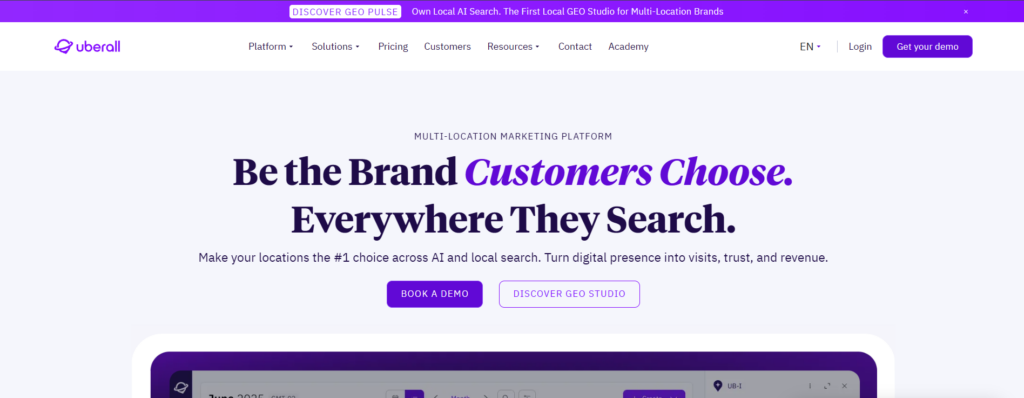
Best for: Larger franchise and multi-location brands that need listings, reputation, and local social under one sales-led platform with explicit corporate, franchisee, or shared control.
What it does: Uberall is a multi-location marketing platform that syncs location data across directories, manages reviews, and adds local social plus optional AI-search modules. Uberall franchise pages describe three operating models: centralized, decentralized, and collaborative with role-based access. Uberall is a governed presence system, not a self-serve audit toolkit.
Key capabilities:
- Listings sync across 150+ directories, including Google, Apple Maps, Yelp, Bing, and AI search surfaces, plus duplicate suppression and profile protection
- Review inbox, AI reply drafts, review generation, and optional Reviews Plus
- Local social on the Connect package, with templates, a publishing calendar, and dynamic fields
- Bulk edits by spreadsheet or API, scheduled location updates, and unlimited users
- Collaborate Plus for flexible permissions, SSO, white label, and approval workflows
- GEO Studio as an add-on for AI-search share-of-voice work
Franchise permissions and brand consistency: Uberall documents franchise control in the most detail in this set. Corporate can lock core brand elements and still let a store manager change hours or reply to a review. Collaborate Plus adds approval queues. Uberall also sells a mobile workflow so a franchisee can update hours or post a photo without waiting on a brand marketing ticket.
Bulk updates and new-unit duplicates: Uberall supports bulk upload and bulk edit for hours, descriptions, services, and images. Profile protection is meant to block unauthorized third-party edits and suppress duplicates so a new unit does not sit next to an old listing. Confirm how Uberall handles a store that is opening soon.
Reviews and SLAs: Uberall Stand Out and Connect include a review inbox, AI-assisted replies, a response library, and alerts. Franchise material treats a 24-to-48-hour reply window as the customer expectation. Local social is not in the listings-only Show Up package; budget Connect if franchisees are expected to post.
Pricing: Custom / Contact vendor. Official packages are Show Up (listings), Stand Out (listings plus reviews), and Connect (adds local social). Add-ons include Reviews Plus, Analytics Plus, Collaborate Plus, locator pages, Social Ads, and GEO Studio. Treat third-party per-location figures as unverified.
Important consideration: Uberall is built for larger footprints and a sales process. A rank-tracking-only shop or an agency that only sells monthly audits will overbuy. If you need public pricing and a 14-day trial, compare BrightLocal or Synup first.
Also consider: Yext and SOCi
Yext and SOCi sit above this comparison when the franchise is already an enterprise buyer.
It is an enterprise listings and knowledge platform. Yext stores location facts in a Knowledge Graph and distributes verified data directly to 200+ publishers. Yext pricing is Custom / Contact vendor.
SOCi is a franchise-oriented local marketing cloud that combines listings, reviews, social, and brand governance. SOCi pricing is Custom / Contact vendor.
Keep this pair as a second demo list. Do not let either one replace a fair read of BrightLocal, Synup, and Uberall for the job you actually have.
Which platform fits which franchise?
Use the framework, then match the bottleneck.
Under about 25 locations, with a central SEO or agency team, and a need for audits, citations, and rank proof: start with BrightLocal. Add Synup if you also need 100+ publisher syndication and a client portal.
Agency-run franchise retainers that must look like the agency, with listings and reviews in one bill: compare Synup Premium or Pro against BrightLocal Grow plus a separate listings vendor.
50-plus locations, frequent openings, and a real corporate-versus-franchisee permission split: compare Uberall. Add Yext if you need a Knowledge Graph and 200+ direct publishers. Add SOCi if social governance is the main gap.
Reviews owned by franchisees with a 24-hour SLA: pick the platform they will open daily. Synup and Uberall both put replies next to listings. BrightLocal Grow can do the inbox if the same team already lives in BrightLocal.
New units every month: prioritize duplicate suppression and bulk create. Uberall and Synup document that job. BrightLocal covers it through Citation Builder plus Active Sync on key sites.
Budget first, contract later: BrightLocal and Synup publish rates. Uberall, Yext, and SOCi do not.
Keep one system of record for NAP. Add a specialist tracker only when the primary platform cannot answer a rank or citation-gap question.
Frequently asked questions
What is the best listings management platform for franchises in 2026?
There is no single best platform. BrightLocal fits franchise teams that need audits, citations, rank tracking, and key-site listing control. Synup fits franchise and agency teams that need listings, reviews, and white-label operations on a published price. Uberall fits larger networks that need listings, reviews, and local social with documented corporate and franchisee roles. Start from location count and who is allowed to edit the profile.
How much do BrightLocal, Synup, and Uberall cost in 2026?
BrightLocal starts at $41 per month for one location on Track, according to the Help Center table dated 29 June 2026. Synup starts at $49 per month for one location on Solo, with Premium at $299, Pro at $499, and Scale at $899. Uberall is Custom / Contact vendor. Confirm live pages before you buy.
Who should own Google Business Profiles in a franchise?
Corporate ownership is cleaner for brand name, category, and duplicate cleanup. Franchisee ownership is faster for photos, posts, and review replies. Most networks keep corporate as the primary owner and grant franchisees manager access inside the listings platform. Write the ownership rule into the franchise operations manual before you migrate profiles.
How should a franchise handle duplicate listings when a new unit opens?
Create the location in one system of record, claim or create the Google Business Profile from that record, and run a duplicate scan before launch advertising starts. Synup groups suspected duplicates in a queue. Uberall uses profile protection and duplicate suppression. BrightLocal Citation Builder can find and remove duplicates. Do not let the franchisee and the agency each create a profile for the same address.
Do franchisees need their own logins?
Yes, if they are expected to reply to reviews or update hours inside an SLA. No, if corporate or an agency runs every profile. Synup and Uberall are built for franchisee logins with scoped permissions. BrightLocal is typically run by a central team. Do not share one master password across 80 stores.
Final takeaway
Pick a franchise listings platform by the job and the permission model, not by a generic best-of label. BrightLocal, Synup, and Uberall each solve a different bottleneck: practitioner audits and key-site sync, presence operations with a published price and white-label portal, or enterprise listings, reviews, and local social with role-based control. Start with location count, corporate versus franchisee control, update frequency, reviews and listings ownership, integrations, and budget. Keep one system of record. Add Yext or SOCi only when the network already needs that enterprise layer.