

The best local SEO tools are BrightLocal, Local Falcon, Semrush Local, Synup, Uberall, Whitespark, and Yext. None is a universal winner. BrightLocal and Whitespark suit audits, citations, and rank tracking. Local Falcon measures geo-grid and AI-search visibility. Semrush Local fits teams already using Semrush. Synup serves agency and multi-location operations. Uberall and Yext target enterprise location governance. Choose by locations, update frequency, governance, reviews and SEO needs, integrations, and budget.
Local SEO tools compared
These products are not interchangeable. Confirm current pricing with each vendor. Public rates below are from official pages as of August 2026.
| Tool | Best For | Key Strength | Pricing |
|---|---|---|---|
| BrightLocal | Audit and reporting teams | Tracking, citations, GBP audits | From $41/mo (1 location) |
| Local Falcon | Geo-grid and AI measurement | Map and AI search grids | From $24.99/mo |
| Semrush Local | Existing Semrush users | GBP automation, listings, reviews | $30-$60 per location/mo |
| Synup | Agencies and multi-location teams | Listings, reviews, white-label | From $49/mo (1 location) |
| Uberall | Global multi-location brands | Listings, reviews, local social | Custom / Contact vendor |
| Whitespark | Specialists buying a la carte | Citations, tracking, GBP protection | From $1 per location/mo |
| Yext | Large enterprises | 200+ publishers, data governance | Custom / Contact vendor |
How we evaluated these tools
We compared these platforms as working software for local search operations, not as a ranked awards list. The question was which job each product is built to do, and which team would overbuy if they picked it for the wrong job.
Criteria:
- GBP control: audits, posts, photos, listing sync, and alerts for rejected or missing updates
- Rank and geo-grid tracking: pack and map measurement from more than one point
- Listings and citations: directory distribution, duplicate suppression where documented, and citation research versus one-way push
- Reviews: monitoring, reply workflows, and generation tools
- White-label delivery and reporting for agency or franchise packaging
- Multi-location permissions: practitioner toolkit versus a governed source of truth
- AI features: whether the product measures visibility in AI answers, generates GBP content, or both
Pricing is from official pages as of August 2026. Unpublished rates are Custom / Contact vendor. We did not run a paid bake-off of every SKU, and we did not treat directory count as quality. No tool can guarantee Google or AI rankings. Measurement of pack, map, or AI-answer visibility is not a ranking promise.
BrightLocal
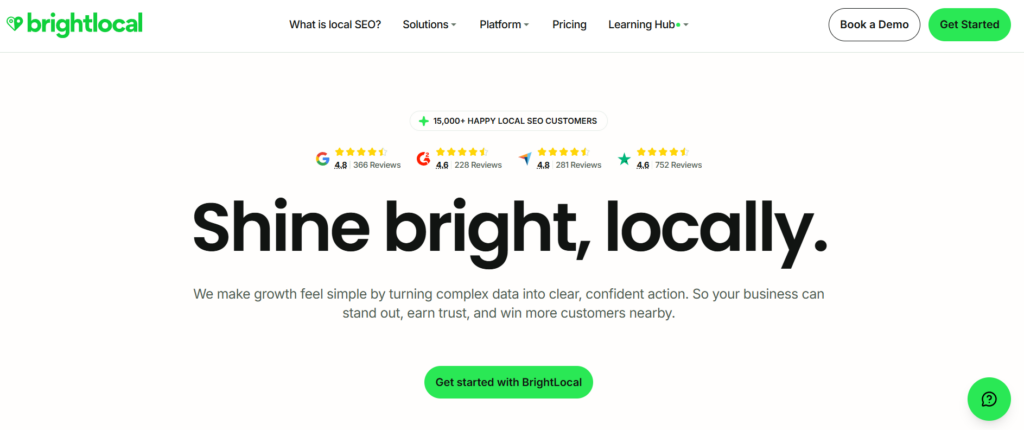
Best for: Agencies and small-to-mid businesses that need audits, rank tracking, citations, and reporting in one specialist local SEO suite.
What it does: BrightLocal is a practitioner-focused platform for diagnosing local visibility problems and measuring pack and map results. It is built around the monthly work local SEO teams actually do: check where a business ranks from different points, find citation gaps, audit Google Business Profile health, and package findings into reports.
Key capabilities:
Local Rank Tracker and Local Search Grid for pack and map measurement
Citation Tracker and a pay-as-you-go Citation Builder
GBP audits, listing sync, posts, and Grow-plan review tools
Reporting suited to recurring audit and ranking work
Pricing: Track is $41, Manage is $54, and Grow is $65 per month for one location, according to the BrightLocal Help Center. Annual billing is about 25% off. Citation Builder starts from $2 per citation. Confirm the Help Center figures before you buy, because the marketing pricing page may currently show price on request.
Important consideration: BrightLocal is built for practitioner audits and measurement, not for enterprise location governance with complex permissions across hundreds of locations.
Example: A five-location dental group is losing map-pack visibility in two suburbs. The SEO lead runs Local Search Grid scans, compares citation completeness in Citation Tracker, then uses Citation Builder for missing directories.
Who should skip: Skip BrightLocal if you need governed permissions across a large multi-country footprint, or if listings already live elsewhere and you only need AI-answer measurement.
Local Falcon
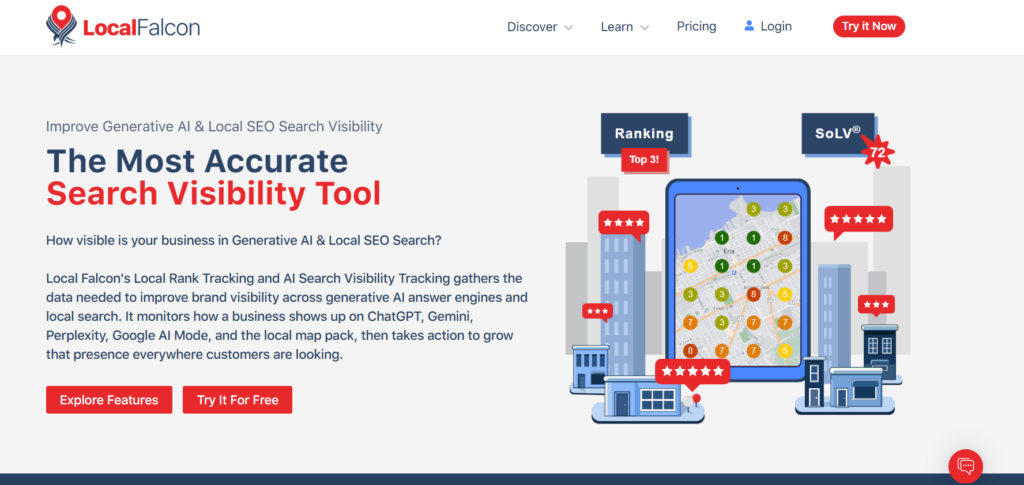
Best for: Teams that need geo-grid rank tracking and AI-search visibility measurement rather than a full listings or review platform.
What it does: Local Falcon shows how a business ranks from many points around a location on maps and AI platforms, instead of returning one city-wide rank. A restaurant can sit in the local pack from the office ZIP code and disappear three kilometers away. Local Falcon answers where you show up more than it publishes NAP data.
Key capabilities:
Geo-grid scans for Google Maps and Apple Maps
AI tracking for ChatGPT, Gemini, AI Overviews, AI Mode, and Grok
Campaigns, competitor reports, and Share of Local Voice
GBP alerts alongside the tracking workflow
Pricing: Credit-based plans run from $24.99 per month (Starter, 7,500 credits) to $199.99 per month (Premium). Extra credits are $0.05 each. Heavy grid density, frequent recrawls, and AI scans consume credits faster, so model usage before you pick a tier.
Important consideration: Local Falcon does not replace a listings system of record. Most teams still need a separate platform to publish business data and manage reviews.
Example: A coffee chain wants to know whether a competitor is taking the map pack near transit stops. The team runs Google Maps grids at those points, compares Share of Local Voice, and adds ChatGPT and AI Overviews tracking for nearby queries.
Who should skip: Skip Local Falcon if you only need citation building, review replies, or directory distribution. It is the wrong first purchase while listings data is still inconsistent.
Semrush Local
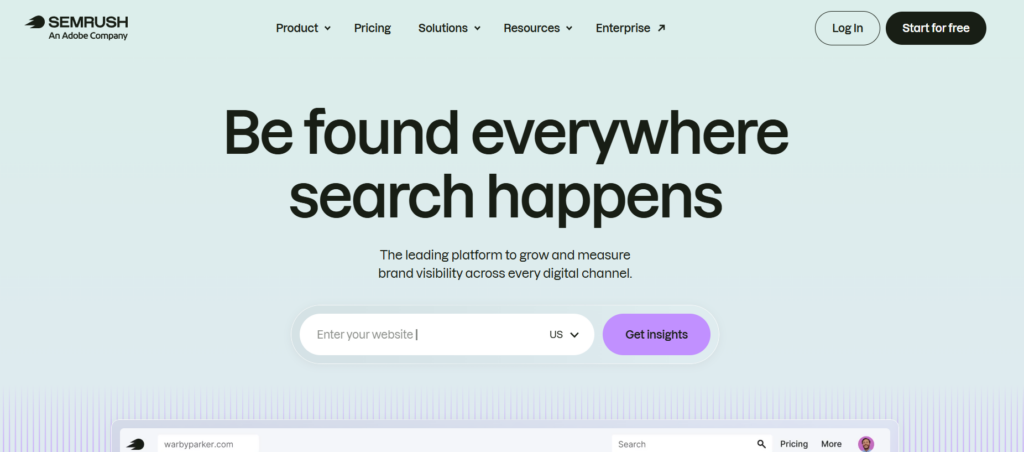
Best for: Marketers who want local SEO tools inside the Semrush ecosystem rather than a standalone local platform.
What it does: Semrush Local combines GBP automation, geo-grid map tracking, listings, and reviews. It is sold per location as an add-on or standalone toolkit, which is convenient if the same team already uses Semrush for keywords and site audit. Cost scales with location count instead of a portfolio band.
Key capabilities:
GBP AI Agent for posts, photos, descriptions, and review replies
Map Rank Tracker with geo-grid credits
Listing management across 70+ directories on Local Pro
Review tools in the same per-location toolkit
Pricing: Local Base is $30 per location per month. Local Pro is $60 per location per month. Local Business is custom for 20 or more locations. A 10-location Local Pro rollout is therefore about $600 per month before any other Semrush subscription.
Important consideration: Because price is linear by location, large portfolios should compare band-priced or enterprise platforms before assuming Semrush Local is the cheapest way to cover every store.
Example: A regional home-services brand already uses Semrush for organic research. Local Pro lets the same users automate GBP posts, track map ranks, and push listings to 70+ directories. At 40 locations, they should re-quote Local Business and compare a band-priced listings platform.
Who should skip: Skip Semrush Local if you are not already in Semrush and your main need is citation research, dense geo-grids, or enterprise publisher governance.
Synup
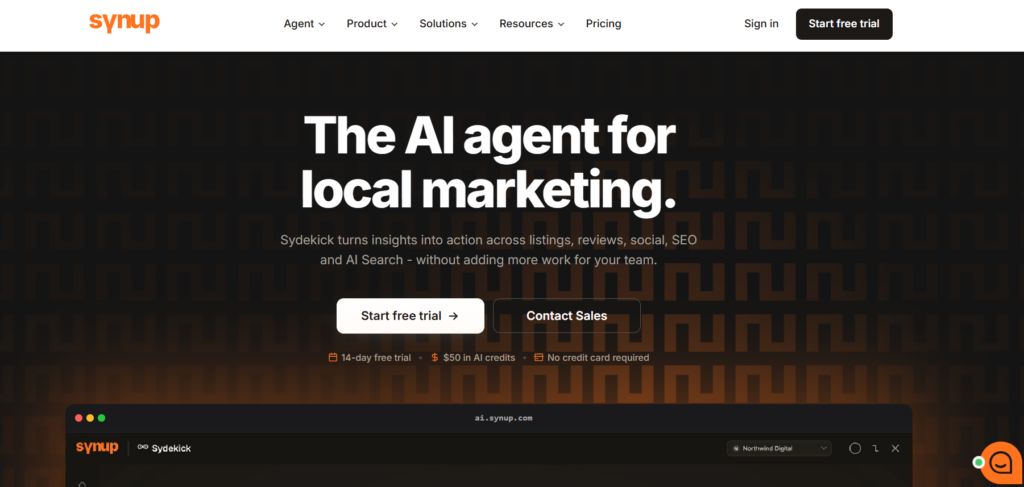
Best for: Agencies and multi-location teams that need listings, reviews, reporting, and white-label delivery together.
What it does: Synup is a local presence platform that publishes business data to directories, monitors reviews, tracks local visibility, and packages client reporting. It is an operating layer for a portfolio: keep location facts current, watch reputation, and send branded reports, rather than a specialist citation-research or geo-grid lab.
Key capabilities:
Listings distribution across 100+ publishers
Review monitoring, responses, and generation
Local rank grid and visibility scoring
White-label reports on Premium and higher plans
Pricing: Public bands run from $49 per month for one location (Solo) to $899 per month for up to 50 locations (Scale). Premium is $299, and Pro is $499. Annual billing saves 20%. Enterprise is custom above 50 locations. Confirm current bands on synup.com/en/pricing; older OS Base + Listings Pro cards at $35 are stale.
Important consideration: Synup is not a deep citation-research specialist. Teams that need competitor citation gap mining should pair it with a finder tool or choose a citations-first product for that job.
Example: An agency manages 18 multi-location clients and needs one place to push listings, answer reviews, and export white-label reports. Premium or Pro covers that operating work. Neighborhood heatmaps or AI-answer tracking still belong on a specialist tracker.
Who should skip: Skip Synup if you only need rank tracking for a few keywords, or if you need a Knowledge Graph, 200+ publisher contracts, and legal-grade location governance.
Uberall
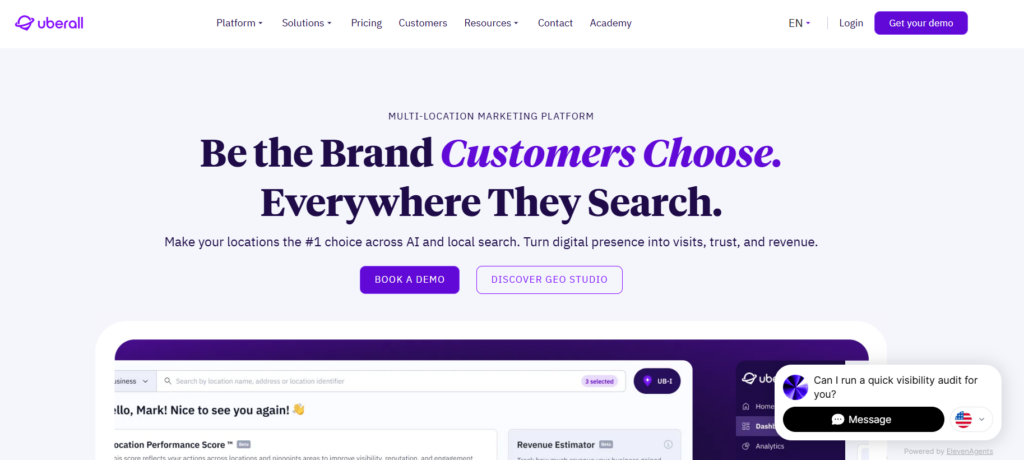
Best for: Global multi-location brands that need listings, reputation, and local social under central control.
What it does: Uberall is a multi-location marketing platform that syncs location data across directories, manages reviews, and adds local social plus AI-search modules. It is built for brands that cannot let each franchisee keep a different phone number or hours page, and that want listings, reviews, and local social in one sales-led suite.
Key capabilities:
Listings sync across 150+ directories, plus duplicate suppression
Review inbox, AI reply drafts, and review generation
Local social on the Connect package
GEO Studio as an add-on for AI-search related work
Pricing: Custom / Contact vendor. Packages are Show Up (listings), Stand Out (listings plus reviews), and Connect (adds local social). GEO Studio is positioned as an add-on, so budget for modules rather than a single public sticker price. Billing and minimums are sales-led.
Important consideration: Uberall is built for larger footprints. A rank-tracking-only shop, a single-location business, or an agency that only sells monthly audits will overbuy.
Example: A 200-location retailer keeps finding duplicate listings after acquisitions. Show Up or Stand Out becomes the listings and reviews system of record; Connect adds local social if store-level posts are in scope; GEO Studio is evaluated separately for AI-search tooling.
Who should skip: Skip Uberall if you need a $25-$65 monthly tracker, a la carte citation research, or a tool you can buy without a sales cycle.
Whitespark
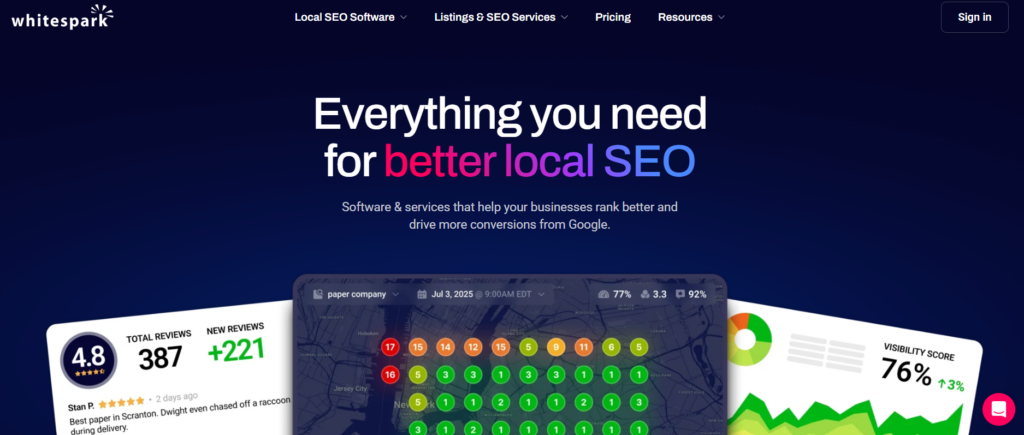
Best for: Specialists who prefer purpose-built tools for citations, rankings, GBP protection, and reviews instead of one bundled suite.
What it does: Whitespark sells modular software rather than one bundle, so teams can buy only the citation, rank-tracking, GBP, or reputation product they need. That is useful when the bottleneck is a specific job: competitor citations, ranking grids, or rejected GBP updates.
Key capabilities:
Local Citation Finder for competitor citation gaps
Local Rank Tracker and Local Ranking Grids
Local Platform for GBP alerts, bulk edits, and rejected updates
Reputation Builder as a separate reputation module
Pricing: Modular list prices: Local Platform is $1 per location per month on annual billing; Local Ranking Grids start from $10 per month; Local Rank Tracker starts from $14 per month on annual billing; Local Citation Finder starts from $33 per month on annual billing; Reputation Builder is $79 per location per month. Confirm current figures on whitespark.ca/pricing.
Important consideration: Modular pricing is economical for one job. Costs add up if you subscribe to several Whitespark tools and still need a listings distributor.
Example: A consultant is hired to repair citations for a law firm. Local Citation Finder maps competitor gaps, Local Rank Tracker watches a short keyword set, and Local Platform flags rejected GBP updates. Reputation Builder and an enterprise listings network are out of scope.
Who should skip: Skip a full Whitespark stack if you need one vendor for listings, reviews, white-label portals, and publisher distribution. Modular tools will not become that operating layer.
Yext
Best for: Large enterprises that need structured location data, publisher distribution, and governed updates.
What it does: Yext stores location facts in a Knowledge Graph and pushes verified data to search, maps, directories, and AI discovery surfaces. It is a system of record for businesses that treat hours, holidays, amenities, and entity attributes as operational data, not as a one-time NAP submission.
Key capabilities:
Direct distribution to 200+ publishers, including Google, Apple, Bing, Facebook, and Yelp
Listings, reviews, pages, social, and analytics modules
Scout for measuring traditional and AI search visibility
Knowledge Graph as the source of truth for location facts
Pricing: Custom / Contact vendor. Yext prices by solution, location count, and contract term. Billing is typically annual. There is no reliable public per-location sticker price, so treat any third-party from-X figure as unverified.
Important consideration: Yext is built for serious multi-location programs. Rank-tracking-only buyers, single-location shops, and agencies that only need citation finders will usually overbuy.
Example: A national bank has 800 branches and a requirement that every map listing matches the Knowledge Graph. Listings and pages modules keep publishers in sync; Scout measures classic local results and AI answers. A geo-grid tool is added only if Scout cannot answer a market-specific heatmap question.
Who should skip: Skip Yext if you have a few locations, you only need monthly rank tracking, or you are not ready for an annual enterprise contract. Practitioner tools will do the same audit work for less.
How should you choose a local SEO tool?
Walk this order: Locations, Update Frequency, Governance, Reviews and SEO Needs, Integrations, then Budget. Changing the order is how teams buy enterprise software for a tracking job, or a $25 grid tool for a 200-location data problem.
Locations. One site is a practitioner problem. Fifty to several hundred locations is a data-sync and permissions problem. Count locations first: some products price per location, others in bands or by contract.
Update Frequency. If hours, menus, or closures change weekly, you need a listings system of record with sync. If the profile is stable and the job is diagnosis, a tracker plus citation research is enough.
Governance. Ask who can edit a listing, who approves a review reply, and what happens after an acquisition creates duplicates. Practitioner tools assume a small team; Uberall and Yext assume central control.
Reviews and SEO Needs. Separate reputation work from rank measurement. Review inboxes do not replace geo-grids. Grids and AI-mention tracking do not replace review response SLAs.
Integrations. Stay inside Semrush if that is already the daily workspace and location count is modest. Keep one listings system of record if you already have Yext, Uberall, or Synup.
Budget. Public entry points range from Local Falcon at $24.99 per month and BrightLocal Track at $41, through Synup Solo at $49, up to custom enterprise quotes. Semrush Local Pro at $60 times 50 locations is $3,000 per month; Synup Scale lists $899 per month for up to 50. That is a pricing-shape difference, not a quality ranking.
Four working examples:
Single-location business. Start with BrightLocal Track or Manage, or Whitespark Rank Tracker plus Citation Finder. Add Local Falcon for neighborhood heatmaps or AI-answer mentions. Do not buy Yext or Uberall for one shop.
Agency. Use BrightLocal for audits, tracking, and reporting. Compare Synup when retainers also include listings, reviews, and white-label reports. Keep Whitespark Citation Finder for gap research.
50-location franchise. Synup Scale is a public band for up to 50 locations. Linear Semrush Local pricing gets expensive at this size, so re-quote Local Business or compare total cost. Use Local Falcon or BrightLocal grids for visibility QA. Look at Uberall or Yext for duplicate suppression or a governed publisher network.
Enterprise. Compare Yext and Uberall as the listings system of record. Use Yext Scout, Uberall modules, or Local Falcon to measure traditional and AI visibility. Do not replace the system of record with a credit-based grid tool.
Do you need one local SEO tool or a stack?
One tool is enough when the job is narrow: track a few keywords, clean citations for one location, or automate GBP posts for a small set of profiles. A stack makes sense when listings, reputation, and rank measurement are separate jobs with different owners.
Keep one system of record for name, address, phone, hours, and attributes. That is usually BrightLocal listing sync, Semrush Local Pro, Synup, Uberall, or Yext, depending on size. Then add a specialist only for a question that system cannot answer: Whitespark Local Citation Finder for competitor citation gaps, Local Falcon for dense geo-grids and AI-search mentions, or BrightLocal Local Search Grid for pack and map audits.
Two listings platforms creating competing updates is a common failure mode. Do not add a second distributor just in case, and do not buy a second tracker unless it measures a surface the first one cannot.
Can local SEO tools improve AI search visibility?
They can help with the inputs that AI systems and search engines read: accurate location data, complete profiles, reviews, and consistent publisher facts. Several vendors also measure whether a brand appears in AI answers. Local Falcon tracks ChatGPT, Gemini, AI Overviews, AI Mode, and Grok. Yext Scout measures traditional and AI search visibility. Uberall offers GEO Studio as an add-on.
That is visibility measurement, not a ranking guarantee. No platform can promise citations in ChatGPT, Gemini, Google AI Overviews, AI Mode, or similar systems. Treat AI tracking like geo-grid tracking: it tells you where you showed up on a scan, on a date, for a query. It does not mean the vendor controls the model.
If AI-search reporting is a board request, buy a measurement module and keep the listings system of record.
Frequently asked questions
What is the best local SEO tool in 2026?
There is no single best tool. BrightLocal and Whitespark fit audit, citation, and tracking work. Local Falcon fits geo-grid and AI visibility measurement. Semrush Local fits teams already in Semrush. Synup fits agencies that need listings, reviews, and client reporting together. Uberall and Yext fit large brands that need governed location data. Start from the bottleneck, not from a ranking list.
How much do local SEO tools cost in 2026?
Public starting points are Local Falcon from $24.99 per month, BrightLocal from $41 per month for one location, Synup from $49 per month for one location, Semrush Local from $30 per location per month, and Whitespark Local Platform from $1 per location per month on annual billing. Uberall and Yext are custom.
Is geo-grid tracking worth it for one location?
Yes, when customers search from many nearby points and the map pack changes by neighborhood. Local Falcon and BrightLocal Local Search Grid both address that. Skip a dense grid if you only need a city-level rank.
Should a small brand buy enterprise listings software?
Usually no. Yext and Uberall are built for large footprints, publisher contracts, duplicate suppression, and permissions. A small team will typically get more from BrightLocal, Whitespark, Synup Solo, or Semrush Local than from an annual enterprise contract.
Do citation tools still matter if you already syndicate listings?
Yes, when you need competitor citation gaps, unmanaged duplicates, or a market the syndication network does not cover well. Whitespark Local Citation Finder is the specialist for that research. Syndication from Synup, Semrush Local Pro, Uberall, or Yext is a push of your data, not a substitute for competitor analysis.
Final takeaway
Pick a local SEO tool by the job you need done, not by a generic best-of label. BrightLocal, Local Falcon, Semrush Local, Synup, Uberall, Whitespark, and Yext each solve a different bottleneck: audits, geo-grid measurement, Semrush-stack local work, agency presence operations, enterprise governance, specialist citations and tracking, or structured publisher distribution. Start with locations, update frequency, governance, reviews and SEO needs, integrations, and budget. Keep one system of record. Add a specialist only when it answers a question the primary tool cannot.