

10 Best Yext Alternatives for Local Listings Management in 2026 include a mix of full local SEO platforms and free profile-management tools for businesses that want more control over cost, location data, reviews, and reporting. This guide compares Synup, Google Business Profile, Apple Business, Uberall, BrightLocal, Moz Local, Semrush Local, Birdeye, Whitespark, and LocalClarity. The best Yext alternatives vary by location count, agency needs, directory coverage, and budget. You’ll see current pricing where vendors publish it, the trade-offs behind each option, and what to check before moving listings away from Yext.
What are Yext alternatives?
Yext alternatives are tools businesses use instead of, or alongside, Yext to manage location information across search engines, maps, directories, review sites, and other discovery platforms.
The basic job sounds simple: keep your business name, address, phone number, opening hours, categories, website, services, photos, and other location data accurate wherever customers search. The difficulty grows quickly when a company has 20, 200, or 2,000 locations.
Yext currently distributes business information through a network of more than 200 publishers and offers listings, reviews, local pages, social tools, analytics, APIs, and a structured Knowledge Graph.
That breadth works well for some organizations. Others consider Yext competitors because they want:
- Lower or more predictable per-location pricing
- Agency and white-label controls
- A narrower platform focused mostly on listings
- Pay-as-you-go citation building
- Better local rank tracking
- Direct Google Business Profile management
- Review management in the same subscription
- Fewer features than a large enterprise platform
- Different contract terms
- More control over which directories receive their information
There is no universal best alternative to Yext. A one-location plumber, a local SEO agency managing 50 clients, and a restaurant chain with 1,000 locations need different tools.
Yext alternatives compared
| Yext alternative | Best for | Listings coverage | Reviews | Local rank tracking | Starting pricing |
|---|---|---|---|---|---|
| Google Business Profile | Small businesses focused on Google | Google only | Yes | No built-in full rank tracker | Free |
| Synup | Agencies and multi-location businesses | 75+ directories on Listings Pro | Available | Included on listings plans | $35/location/month for Listings Pro, plus Synup OS |
| Apple Business | Businesses managing Apple visibility | Apple properties | Limited compared with reputation platforms | No | Free |
| Uberall | Large multi-location brands | Broad publisher network | Yes | Available | Custom quote |
| BrightLocal | SMBs and local SEO agencies | Listings sync plus citation building | Yes on higher plans | Yes | Manage from $40/month annually for one location |
| Moz Local | SMBs and local SEO teams | Multi-directory distribution | Yes | Geo/local features vary by plan | Around $16/location/month annually based on currently reported pricing |
| Semrush Local | Businesses combining listings and local search measurement | 70+ directories on Local Pro | Yes | Yes | $60/location/month annually for Local Pro |
| Birdeye | Multi-location reputation and listings programs | 50+ sites depending on package | Yes | Available | Custom quote |
| Whitespark | Businesses focused on Google profiles and citations | Primarily GBP plus separate citation services | Separate tools/services | Yes through separate products | $1/location/month for Local Platform |
| LocalClarity | Multi-location teams needing flexible workflows | Google, Apple, Bing, Facebook and other connections | 50+ review sources | Available | $16/location/month or $12 annually |
Pricing checked in August 2026. Vendors can change plans, location limits, directory networks, and contract terms, so request a current quote before making a final decision.
1. Google Business Profile
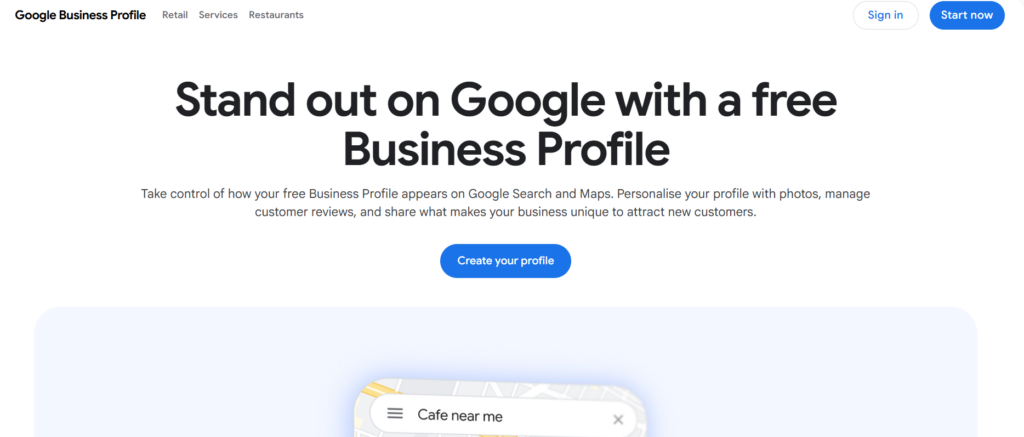
Google Business Profile is the most practical free Yext alternative for a small business that mainly cares about Google Search and Maps.
Verified businesses can manage their name, address, phone number, hours, website, service areas, photos, business attributes, posts, and customer reviews without paying for third-party local listings management software. Google confirms that Business Profiles can be managed at no charge.
Google has also expanded how businesses can work with profiles. Gemini can now help eligible users review profile information, work with reviews, draft replies, create posts, and inspect performance data.
Best for: Single-location companies, small service businesses, restaurants, stores, and owners whose customers primarily find them through Google.
Where it falls short: Google Business Profile only controls your Google presence. It does not synchronize your information to Apple, Facebook, Yelp, TripAdvisor, industry directories, or dozens of citation sources.
A company with one or two locations can often start here before buying local listings management software. Once location count rises or the business needs cross-platform data control, manual management becomes harder.
Pricing: Free.
2. Synup
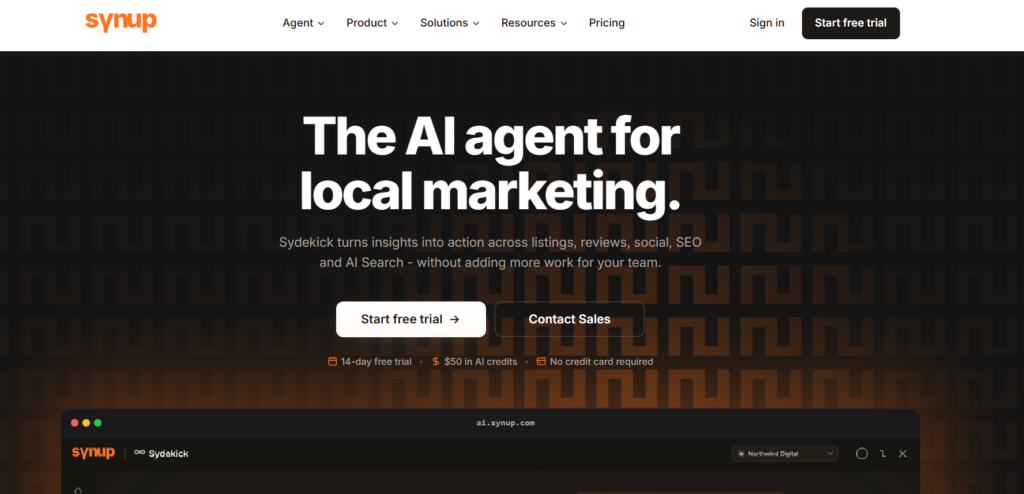
Synup is one of the better Yext alternatives for agencies and businesses that want listings, reviews, local reporting, and client management under the same account.
Its Listings Pro product distributes business data to more than 75 directories and supports bulk listing connections and edits, duplicate suppression, local posting, profile automation, search visibility measurement, and local keyword tracking.
Agency accounts sit on Synup OS. The Startup plan supports up to 25 client accounts and includes listings and review-management capacity for up to 25 locations. Agency and Scale tiers increase client, user, and location limits. White-labelled emails, API access, client dashboards, and broader agency controls are available depending on the plan.
Best for: Local SEO agencies, resellers, franchise marketing teams, and multi-location businesses that want more than citation distribution.
Where it differs from Yext: Synup concentrates heavily on agency operations and combines listings with review, social, and local SEO add-ons. Yext has a much larger stated publisher network and a broader enterprise data platform.
Pricing: Listings Pro costs $35 per location per month and is sold as an add-on to Synup OS. Synup OS starts at $79 per month when billed annually or $99 monthly.
3. Apple Business
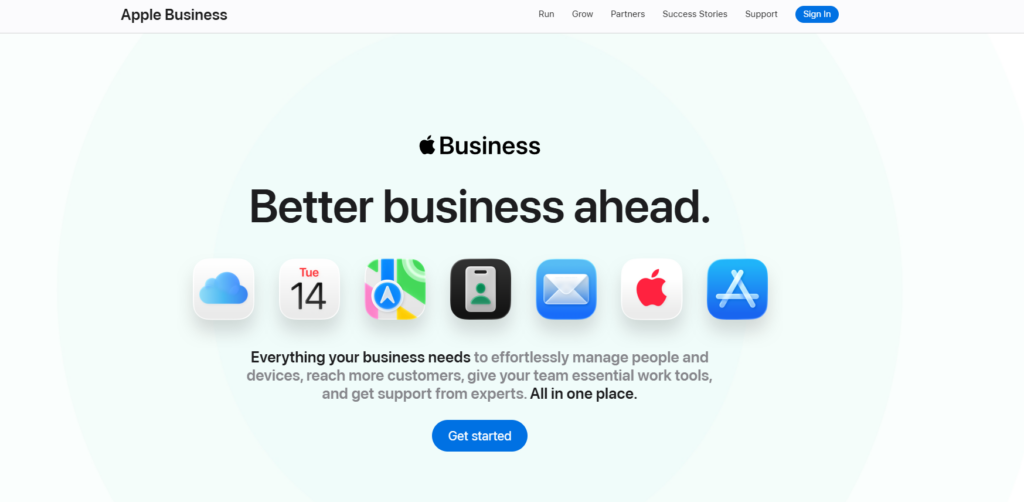
Apple Business is a free option for companies that want direct control over how their locations appear across Apple services.
In 2026, Apple combined Apple Business Connect, Apple Business Manager, and Apple Business Essentials into Apple Business. Existing Apple Business Connect users can migrate into the newer system.
For location marketing, businesses can manage information associated with their locations and brands, while agencies can register as third-party partners to manage data for clients. Apple Business information can appear in services including Maps and other Apple experiences.
Best for: Businesses that want direct control of Apple location data without paying a listings provider.
Where it falls short: Apple Business manages the Apple side of your local presence. It does not act as a central location management platform for Google, Bing, Facebook, Yelp, and dozens of other sites. It also lacks the broad review, citation, and local SEO reporting functions found in paid Yext competitors.
Apple therefore works best as one piece of a local presence management process rather than a complete Yext replacement for a large brand.
Pricing: The former Apple Business Connect location and brand-management service is free. Apple described Business Connect as a free business tool before moving those capabilities into Apple Business.
4. Uberall
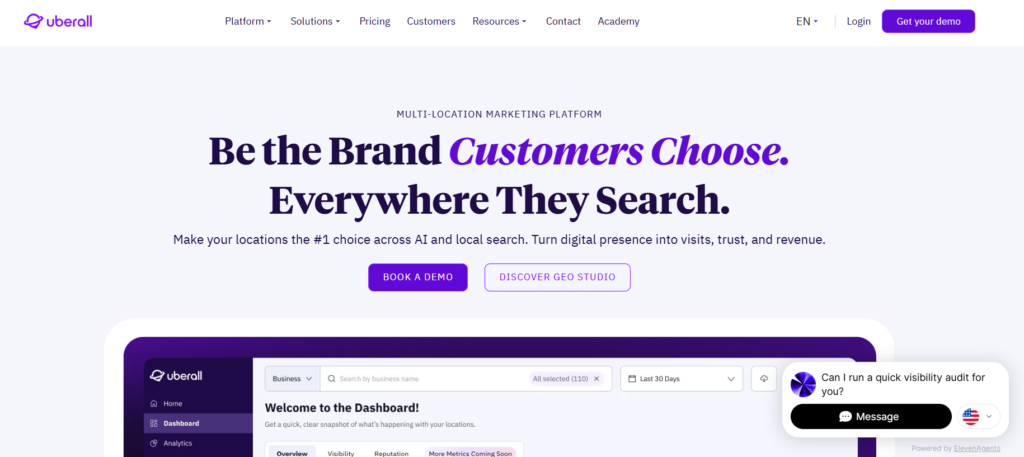
Uberall targets multi-location brands that want listings management combined with reviews, local pages, store locators, analytics, and broader location marketing.
Its current pricing structure starts with an Essentials foundation. The Show Up package adds Listings, while Stand Out combines Listings and Reviews. Businesses can add functions for Google and Apple posting, analytics, collaboration, local pages, and other location-management requirements.
This modular approach makes Uberall one of the more direct Yext competitors for enterprise brands. Both platforms are built around managing local information centrally and distributing it to external services.
Best for: Retail chains, restaurant groups, automotive networks, financial brands, and companies managing a large number of physical locations.
Where it differs from Yext: Yext currently says its network includes more than 200 publisher integrations. Uberall puts considerable attention on multi-location customer journeys, reviews, local pages, store locators, and analytics rather than competing on directory count alone.
Uberall can be attractive when the business wants a complete local presence management software suite but prefers a different operating model or commercial agreement from Yext.
Pricing: Uberall does not publish standard dollar amounts for its main plans. Pricing is supplied through its sales process.
5. BrightLocal
BrightLocal takes a different approach from enterprise platforms. It combines local search measurement, listings management, citation building, Google Business Profile tools, and reputation features while keeping public pricing relatively clear.
Its current plans are Track, Manage, and Grow. Track focuses on rankings, citation auditing, local SEO audits, and competitor measurement. Manage adds listings synchronization and Google Business Profile posting. Grow adds more reputation-related functions.
BrightLocal also sells Citation Builder separately. Businesses can purchase individual citation submissions without maintaining a normal software subscription. Manual submissions start at $3.20 per listing, or as low as $2 when bulk credits are purchased.
Best for: Local SEO agencies, consultants, SMBs, and companies that want rankings and citations without buying an enterprise platform.
Where it differs from Yext: BrightLocal offers more flexibility for one-off citation work. Yext relies on continuous distribution through its publisher network. Businesses should decide whether they need ongoing synchronization or ownership of manually built citations.
Pricing: For one location on annual billing, Track is $31 per month, Manage is $40, and Grow is $49. Monthly billing costs more.
6. Moz Local
Moz Local is a familiar option for businesses that want business listing management software without moving into a large enterprise location platform.
The product is designed around directory management, listing accuracy, review monitoring, local performance, and related local SEO tasks. Higher tiers add review responses, review generation, social functions, competitor analysis, and AI-related features.
Best for: SMBs, agencies, and SEO teams that already use Moz products or want a relatively straightforward local listings platform.
Where it differs from Yext: Moz Local is generally positioned as a lighter self-service product. Yext offers a larger publisher network, deeper enterprise workflows, APIs, local pages, and a structured data platform. That extra breadth can be useful at scale but unnecessary for a smaller company.
Moz Local pricing deserves a little caution. Moz’s current official Local pricing pages were not reliably accessible during this review. G2’s 2026 listing reports plans in the $16 to $33 range, while another 2026 pricing review reports annual rates of $16, $24, and $33 per location per month, with monthly billing at $20, $30, and $40.
Pricing: Reported from about $16 per location per month on annual billing. Confirm directly with Moz before purchase.
7. Semrush Local
Semrush Local is a strong alternative for businesses that want local listings management alongside map ranking data and Google Business Profile automation.
Semrush currently offers Local Base and Local Pro. Base costs $30 per location per month when billed annually and focuses on Google Business Profile management, automated posting, review replies, photo publishing, and map rank tracking.
Local Pro costs $60 per location per month annually and adds Listing Management, review generation, broader GBP management, and larger Map Rank Tracker allowances. Semrush states that its listing tool distributes business information across more than 70 directories.
Best for: SEO teams already working in Semrush, SMBs that care about Google Maps rankings, and agencies combining organic and local search work.
Where it differs from Yext: Semrush Local connects listing management directly with map rank measurement and the wider Semrush SEO product family. Yext provides a larger stated publisher network and deeper enterprise location-data functions.
Businesses with 20 or more locations can request custom Local Business pricing. Semrush also says users can manage unlimited brands and locations, subject to purchased location capacity.
Pricing: $30 per location per month annually for Base and $60 for Pro. Listings management requires Pro.
8. Birdeye

Birdeye combines local listings management with reputation management, reviews, messaging, social tools, and AI-based local marketing functions.
Its Listings product lets businesses update core profile data centrally and distribute changes to supported sites. Current help documentation says updates can be pushed to more than 50 sites depending on the customer’s plan and package. Birdeye supports information for platforms including Google, Apple, Facebook, Bing, Yelp, and other third-party listings.
Best for: Multi-location companies that want reviews and listings managed through the same vendor.
Where it differs from Yext: Birdeye’s strongest distinction is its connection between listings and customer reputation tools. Yext also has review management, but its stated publisher distribution network is considerably larger at more than 200 integrations.
Birdeye works well when review generation, review responses, customer messaging, and listing accuracy need to sit together. Businesses concerned mostly with citation distribution may end up buying more platform than they need.
Pricing is based on selected products, number of locations, and contract structure. Birdeye confirmed in a 2026 pricing explanation that it does not use one fixed public rate for all businesses.
Pricing: Custom quote.
9. Whitespark
Whitespark suits businesses that want to assemble a local SEO toolkit rather than subscribe to one large bundled platform.
Its Local Platform focuses on Google Business Profile management. Businesses can monitor profile changes, reject unwanted Google updates, edit locations in bulk, manage business information, and work with fields including descriptions, categories, services, photos, hours, attributes, and contact information.
Whitespark sells rank tracking, citation research, and related local SEO products separately. That makes the setup different from Yext, where distribution, structured location data, and other products can sit inside a broader platform.
Best for: Small businesses, local SEO consultants, agencies, and teams that want strong Google profile controls at a low entry cost.
Where it differs from Yext: Whitespark’s $1-per-location Local Platform concentrates primarily on Google Business Profile. It does not replace Yext’s 200+ publisher distribution network. Businesses needing citation work can purchase Whitespark’s other services separately rather than paying for a large bundled platform.
This modular model can save money when the team knows exactly which local SEO tasks it needs.
Pricing: Local Platform costs $1 per month per location when billed annually. Local Ranking Grids start at $10 per month, while other Whitespark products have separate prices.
10. LocalClarity
LocalClarity is built for teams that want detailed location-management workflows without paying enterprise rates from some of the larger local presence platforms.
The platform provides direct management for major networks including Google, Apple, Bing, Facebook, and Trustpilot, along with review monitoring across more than 50 sources. Teams can make bulk edits, monitor listing health, receive change notifications, manage images, and control who can edit specific location data.
One unusual feature is the ability to work with listing information through connected Google Sheets, which can suit teams already managing large datasets in spreadsheets.
Best for: Multi-location organizations, agencies, and teams that want flexible user controls and bulk operations.
Where it differs from Yext: LocalClarity concentrates more heavily on major platforms rather than trying to match Yext’s directory network size. It also publishes standard pricing for its Professional tier, which makes initial budgeting easier.
LocalClarity supports unlimited users and locations within its pricing structure, with enterprise and agency accounts quoted separately.
Pricing: Professional costs $16 per location on monthly billing or $12 per location per month when billed yearly. Enterprise and agency pricing is custom.
What about Bing Places for Business?
Bing Places is another free tool worth using even if you choose paid local listings management software.
Microsoft lets businesses claim existing listings, add new locations, edit business information, upload photos, manage hours and services, and verify locations through Bing Places. Businesses with multiple locations can also use bulk upload functions.
Like Google Business Profile and Apple Business, Bing Places should not be confused with a full Yext replacement.
It controls one part of your local presence. A platform such as Synup, Uberall, BrightLocal, Semrush Local, Birdeye, Moz Local, or Yext can reduce the work involved in maintaining data across several services at once.
For a small company on a tight budget, the free combination of Google Business Profile, Apple Business, and Bing Places can still cover three major discovery systems without software fees.
Which Yext alternative is best for agencies?
Agencies usually need more than listing distribution. They need separate client accounts, user permissions, white-labelled reporting, API access, predictable location pricing, and a way to add new customers without rebuilding workflows.
Synup is one of the clearest agency-focused options in this list. Its OS plans are structured around client counts and include white-labelled communication and client dashboard options depending on the tier. Listings, review management, social tools, and SEO reporting can be added separately.
BrightLocal also works well for agencies that need local rank tracking, citation audits, reporting, and pay-as-you-go citation building.
LocalClarity can suit agencies that prioritize bulk workflows and location-level permissions, while Moz Local remains an option for teams that want a relatively straightforward listings product.
Before choosing, calculate cost for your actual client portfolio. A platform that looks cheap at one location can become expensive at 100 locations.
Which Yext alternative is best for small businesses?
A small business should first ask whether it needs a paid platform at all.
If nearly all discovery happens through Google, start with Google Business Profile. Add Apple Business and Bing Places so the business controls its information on those networks as well.
Paid software becomes more useful when:
- The business has several locations
- Hours or location details change frequently
- Listings contain recurring errors
- Staff spend too much time updating profiles manually
- Reviews need to be managed centrally
- Local ranking reports are required
- Duplicate listings keep appearing
- An agency manages the account
BrightLocal, Whitespark, Moz Local, and Semrush Local can all make sense for smaller organizations depending on the work required.
A business should not pay for 100 functions when it only needs five.
Which Yext alternatives are best for multi-location businesses?
Multi-location businesses should put workflow and data control ahead of entry-level price.
A 500-location company needs to know who can edit business hours, how emergency closures are published, how duplicates are handled, whether changes can be approved before publication, and what happens when an external publisher changes business information.
Yext has extensive enterprise controls and a 200+ publisher network, so any replacement should be tested against those requirements rather than compared only on monthly cost.
Synup, Uberall, Birdeye, LocalClarity, and Semrush Local are worth evaluating for larger location portfolios. The right choice depends on whether the company puts more weight on directory reach, reviews, map rankings, agency workflows, analytics, or price.
Run a controlled trial with a small set of locations before migrating hundreds of profiles.
What should you look for in a Yext alternative?
Publisher coverage
Ask for the actual publisher list for your country and industry.
A platform may advertise 50, 75, 100, or 200 destinations, but only part of that network may matter to your customers.
Direct integrations
Find out whether data goes directly to a publisher or through an aggregator or partner.
Direct integrations can provide faster changes and clearer status reporting, though directory count alone does not determine local search performance.
Data ownership after cancellation
Ask what happens when the contract ends.
Will listings remain live with the last published information? Can information revert? Which publisher accounts belong directly to your business?
Get those answers in writing.
Multi-location workflows
A strong location management software platform should support bulk updates, permissions, audit trails, approvals, duplicate handling, and location grouping.
These functions matter far more at 500 locations than at five.
Reviews
If reviews are part of your local marketing process, check which platforms can be monitored and which allow direct responses.
Review generation, AI-assisted responses, sentiment analysis, and approval rules may cost extra.
Local rank tracking
Listings accuracy and rankings are related tasks, but not every listings product measures Google Maps visibility.
BrightLocal, Semrush Local, Whitespark, Synup, and other local SEO software platforms provide different forms of rank tracking.
Agency functions
Agencies should check:
- White-label dashboards
- Client login limits
- Staff seat limits
- API availability
- Client reporting
- Per-location charges
- Minimum contracts
- Billing controls
- Reseller terms
Total cost
Compare annual cost instead of the first number shown on a pricing page.
Include platform fees, per-location fees, citation charges, review modules, AI add-ons, SMS charges, APIs, onboarding, support packages, and contract minimums.
What should businesses consider before switching from Yext?
Do not cancel Yext first and figure out migration later.
Start by exporting or recording your location information and reviewing which publisher accounts are directly owned by your company. Document usernames, ownership, verification state, categories, hours, attributes, URLs, images, and location identifiers.
Next, compare your current Yext publisher coverage with the proposed replacement.
Move a small group of locations first. Check whether Google, Apple, Bing, Facebook, Yelp, and other priority profiles retain correct information after the new platform starts distributing data.
Watch for duplicate profiles and conflicting updates during the transition.
A cheaper platform is not cheaper if staff must spend hours every week correcting listing errors manually.
Frequently asked questions about Yext alternatives
What are the best Yext alternatives in 2026?
Strong Yext alternatives in 2026 include Synup, Uberall, BrightLocal, Moz Local, Semrush Local, Birdeye, Whitespark, and LocalClarity. Google Business Profile, Apple Business, and Bing Places are useful free tools but do not provide the same cross-directory management as a paid platform.
What is the best alternative to Yext?
The best alternative depends on the business. Synup fits agencies and multi-location teams that want listings plus client-management tools. Uberall suits large location networks. BrightLocal works well for local SEO agencies and SMBs. Semrush Local is useful when map rankings matter. Google Business Profile may be enough for a small single-location company.
Is there a cheaper alternative to Yext?
Yes. Several tools publish lower entry prices or allow businesses to buy narrower sets of functions. Whitespark’s Google Business Profile management starts at $1 per location per month annually. BrightLocal and LocalClarity publish standard plans, while Google Business Profile, Apple Business, and Bing Places are free.
Price alone should not decide a migration because coverage and workflows differ widely.
What is the best Yext alternative for agencies?
Synup is one of the strongest agency-focused choices because its plans support multiple clients, APIs, listings, reviews, reporting, and white-labelled client communication. BrightLocal is another practical choice for agencies that want citation building and local search reporting.
What is the best Yext alternative for small businesses?
Google Business Profile is the best place to start when the business mostly needs Google Search and Maps management. Whitespark, BrightLocal, Moz Local, and Semrush Local add paid tools when the business needs automation, citations, reviews, or local rank measurement.
How do Yext and Synup compare?
Yext states that it distributes business information through more than 200 publisher integrations and provides a wider enterprise platform covering listings, reviews, pages, social, APIs, analytics, and structured data.
Synup Listings Pro covers more than 75 directories and places more attention on agency accounts, white-label tools, review products, and published pricing.
Large global brands may prefer Yext’s network breadth. Agencies and businesses looking for a different pricing and client-management structure may prefer Synup.
How do Yext and Uberall compare?
Both are designed for multi-location businesses. Yext publishes a larger stated publisher network, while Uberall combines listings with reviews, local pages, store locators, analytics, and other local customer-facing functions.
Both generally require sales discussions for larger deployments, so compare proposals using the same location count and feature requirements.
How do Yext and BrightLocal compare?
Yext uses continuous distribution across a large publisher network and is built heavily for enterprise location management.
BrightLocal combines listings with local rank tracking, auditing, reporting, and pay-as-you-go citation building. It can suit SMBs and agencies that want more control over cost and do not require Yext’s full enterprise setup.
Is free local listings management possible?
Yes, but it requires more manual work.
Businesses can directly manage Google through Google Business Profile, Apple through Apple Business, and Bing through Bing Places.
The limitation is that each service must be maintained separately. A paid business listing management platform becomes useful when the number of locations, publishers, or changes makes that process too slow.
Final thoughts
The best Yext alternatives in 2026 fall into several groups rather than one simple ranking.
Google Business Profile, Apple Business, and Bing Places can handle major search and mapping platforms for free if you are willing to manage each one separately. Synup is worth considering for agencies and multi-location businesses that want listings, reviews, reporting, and client-management functions. BrightLocal, Moz Local, Semrush Local, and Whitespark fit businesses with narrower local SEO requirements, while Uberall, Birdeye, and LocalClarity address larger location-management programs in different ways.
Before switching, compare the publishers you actually need, ownership rules, review functions, APIs, local ranking tools, contract terms, and total cost for every location.
The cheapest Yext alternative on a pricing table is not automatically the cheapest one to operate. Choose the platform that removes the most manual work without making you pay for functions your team will never use.